The reaction of ethylene oxide with water to give ethylene glycol (automobile antifreeze) occurs in 96.0% actual yield. How many grams of ethylene glycol are formed by reaction of 35.0 g of ethylene oxide? (For ethylene oxide, MW = 44.0 amu; for ethylene glycol, MW = 62.0 amu.)
검증된 단계별 안내
1
Identify the balanced chemical equation for the reaction: C_2H_4O (ethylene oxide) + H_2O → C_2H_6O_2 (ethylene glycol).
Calculate the moles of ethylene oxide using its molecular weight: moles = \( \frac{\text{mass}}{\text{molecular weight}} \).
Use the stoichiometry of the balanced equation to determine the moles of ethylene glycol produced, noting that the molar ratio is 1:1.
Convert the moles of ethylene glycol to grams using its molecular weight: grams = moles \( \times \text{molecular weight} \).
Adjust the theoretical yield to the actual yield by multiplying by the percentage yield (96.0%).
비슷한 문제에 대한 검증된 영상 답변:
이 영상 해법은 위 문제에 도움이 된다고 튜터들이 추천한 것입니다.
영상 길이:
5m
영상 재생:
0 댓글
주요 개념
질문에 올바르게 답하기 위해 반드시 이해해야 하는 핵심 개념들은 다음과 같습니다.
Stoichiometry
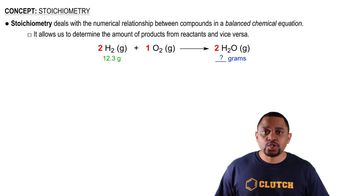
Stoichiometry is the calculation of reactants and products in chemical reactions based on the balanced chemical equation. It allows us to determine the amount of product formed from a given amount of reactant by using molar ratios derived from the coefficients in the balanced equation. Understanding stoichiometry is essential for solving problems involving yields and conversions between grams and moles.
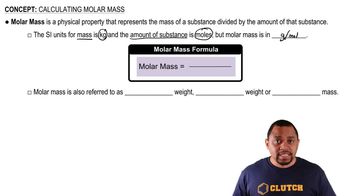
Molar mass is the mass of one mole of a substance, expressed in grams per mole (g/mol). It is calculated by summing the atomic masses of all atoms in a molecule. In this problem, the molar masses of ethylene oxide and ethylene glycol are crucial for converting grams of reactants to moles and subsequently to grams of products, facilitating the yield calculation.
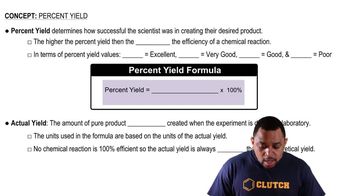
Percent yield is a measure of the efficiency of a chemical reaction, calculated as the ratio of the actual yield to the theoretical yield, multiplied by 100. It indicates how much of the expected product was actually obtained from the reaction. In this scenario, knowing the percent yield (96.0%) is vital for determining the actual amount of ethylene glycol produced from the calculated theoretical yield.

 5:23분
5:23분 검증된 단계별 안내
 01:16
01:16