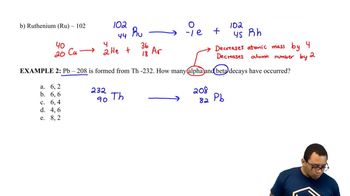
Bismuth-212 attaches readily to monoclonal antibodies and is used in the treatment of various cancers. This bismuth-212 is formed after the parent isotope undergoes a decay series consisting of four α decays and one β decay (the decays could be in any order). What is the parent isotope for this decay series?
검증된 단계별 안내
1
Identify the changes in atomic number and mass number for each type of decay: \( \alpha \) decay decreases the atomic number by 2 and the mass number by 4, while \( \beta \) decay increases the atomic number by 1 and does not change the mass number.
Calculate the total change in atomic number after four \( \alpha \) decays and one \( \beta \) decay: \( 4 \times (-2) + 1 \times (+1) = -7 \).
Calculate the total change in mass number after four \( \alpha \) decays: \( 4 \times (-4) = -16 \).
Determine the atomic number and mass number of the parent isotope by adding the changes to the atomic number and mass number of Bismuth-212: Atomic number of Bismuth is 83, so the parent isotope's atomic number is \( 83 + 7 \). Mass number of Bismuth-212 is 212, so the parent isotope's mass number is \( 212 + 16 \).
Identify the element with the calculated atomic number to find the parent isotope.
비슷한 문제에 대한 검증된 영상 답변:
이 영상 해법은 위 문제에 도움이 된다고 튜터들이 추천한 것입니다.
영상 길이:
4m
영상 재생:
0 댓글
주요 개념
질문에 올바르게 답하기 위해 반드시 이해해야 하는 핵심 개념들은 다음과 같습니다.
Radioactive Decay
Radioactive decay is the process by which unstable atomic nuclei lose energy by emitting radiation. This can occur through various types of decay, including alpha (α) and beta (β) decay. In alpha decay, the nucleus emits an alpha particle, reducing its mass and atomic number, while in beta decay, a neutron is converted into a proton, increasing the atomic number. Understanding these processes is crucial for tracing the decay series leading to the formation of bismuth-212.
A decay series is a sequence of radioactive decays that an unstable parent isotope undergoes until it reaches a stable daughter isotope. Each decay transforms the parent isotope into a new element or isotope, which may also be unstable. In the case of bismuth-212, the decay series involves multiple alpha and beta decays, and identifying the parent isotope requires knowledge of the specific isotopes involved in the series.
Isotope notation is a way to represent isotopes of elements, indicating the element's symbol, atomic number, and mass number. The mass number is the total number of protons and neutrons in the nucleus. For example, bismuth-212 is denoted as Bi-212, where '212' represents its mass number. Understanding isotope notation is essential for identifying the parent isotope in a decay series, as it allows for tracking changes in atomic and mass numbers through the decay process.

 4:32분
4:32분 검증된 단계별 안내
 03:17
03:17