Pure acetic acid, which gives the sour taste to vinegar, has a melting point of 16.7 ° C and a boiling point of 118 ° C . Predict the physical state of acetic acid when the ambient temperature is 10 ° C .
검증된 단계별 안내
1
Identify the melting point and boiling point of acetic acid: 16.7 °C and 118 °C, respectively.
Determine the ambient temperature given in the problem: 10 °C.
Compare the ambient temperature to the melting point: 10 °C is less than 16.7 °C.
Since the ambient temperature is below the melting point, acetic acid will be in a solid state.
Conclude that at 10 °C, acetic acid is expected to be solid because it is below its melting point.
비슷한 문제에 대한 검증된 영상 답변:
이 영상 해법은 위 문제에 도움이 된다고 튜터들이 추천한 것입니다.
영상 길이:
2m
영상 재생:
0 댓글
주요 개념
질문에 올바르게 답하기 위해 반드시 이해해야 하는 핵심 개념들은 다음과 같습니다.
Melting and Boiling Points
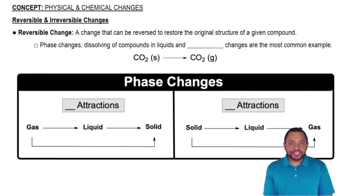
The melting point is the temperature at which a solid becomes a liquid, while the boiling point is the temperature at which a liquid turns into a gas. For acetic acid, the melting point is 16.7 °C and the boiling point is 118 °C. These points are critical for determining the physical state of a substance at a given temperature.
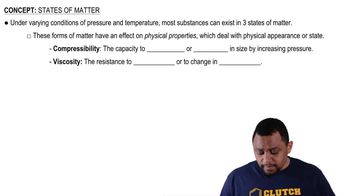
Matter exists in different physical states: solid, liquid, and gas. The state of a substance depends on temperature and pressure. At temperatures below the melting point, a substance is solid; between the melting and boiling points, it is liquid; and above the boiling point, it is gas. Understanding these states helps predict the behavior of substances under varying conditions.
Temperature plays a crucial role in phase changes, which are transitions between solid, liquid, and gas states. When the temperature is below the melting point, a substance remains solid, while temperatures above the boiling point result in a gaseous state. In this case, since the ambient temperature is 10 °C, which is below the melting point of acetic acid, it will remain in a solid state.

 2:05분
2:05분 검증된 단계별 안내
 03:05
03:05