Identify the oxidized reactant, the reduced reactant, the oxidizing agent, and the reducing agent in the following reactions:
a. Fe(s)+Cu₂+(aq) → Fe₂+(aq)+Cu(s)
b. Mg(s)+Cl₂(g) → MgCl₂(s)
c. 2 Al(s)+Cr₂O₃(s) → 2 Cr(s) + Al₂O₃(s)
검증된 단계별 안내
1
Step 1: Understand the concept of oxidation and reduction. Oxidation involves the loss of electrons, while reduction involves the gain of electrons.
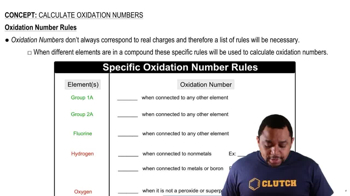
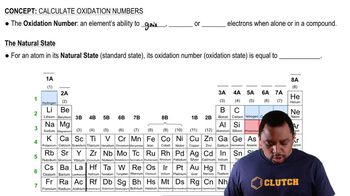
Step 2: Identify the oxidation states of each element in the reactants and products for each reaction.
Step 3: Determine which element's oxidation state increases (oxidized) and which decreases (reduced) in each reaction.
Step 4: Identify the oxidizing agent as the species that is reduced and the reducing agent as the species that is oxidized.
Step 5: Apply these principles to each reaction: a. Fe(s)+Cu₂+(aq) → Fe₂+(aq)+Cu(s), b. Mg(s)+Cl₂(g) → MgCl₂(s), c. 2 Al(s)+Cr₂O₃(s) → 2 Cr(s) + Al₂O₃(s).
비슷한 문제에 대한 검증된 영상 답변:
이 영상 해법은 위 문제에 도움이 된다고 튜터들이 추천한 것입니다.
영상 길이:
7m
영상 재생:
0 댓글
주요 개념
질문에 올바르게 답하기 위해 반드시 이해해야 하는 핵심 개념들은 다음과 같습니다.
Oxidation and Reduction
Oxidation and reduction are chemical processes that involve the transfer of electrons between substances. Oxidation refers to the loss of electrons, resulting in an increase in oxidation state, while reduction is the gain of electrons, leading to a decrease in oxidation state. These processes occur simultaneously in redox reactions, where one substance is oxidized and another is reduced.
An oxidizing agent is a substance that causes another to be oxidized by accepting electrons, while itself being reduced. Conversely, a reducing agent donates electrons to another substance, causing it to be reduced while the reducing agent is oxidized. Identifying these agents is crucial in redox reactions, as they play key roles in the electron transfer process.
Half-reactions are a way to represent oxidation and reduction processes separately. In a half-reaction, the oxidation process shows the loss of electrons, while the reduction process shows the gain of electrons. This method simplifies the analysis of redox reactions, allowing for a clearer understanding of the changes in oxidation states and the identification of reactants and products involved.

 7:48분
7:48분 검증된 단계별 안내
 02:42
02:42