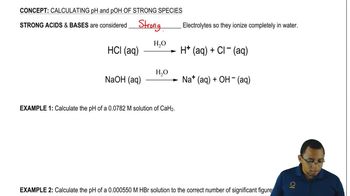
Understand that H⁺ is a hydrogen ion, which is essentially a proton. It is formed when a hydrogen atom loses its electron.
Recognize that H₃O⁺ is the hydronium ion, which is formed when a water molecule (H₂O) gains an H⁺ ion.
Visualize the process: when an acid dissolves in water, it donates an H⁺ ion to a water molecule, resulting in the formation of H₃O⁺.
Note that in aqueous solutions, free H⁺ ions do not exist independently; they are always associated with water molecules, forming H₃O⁺.
Remember that the presence of H₃O⁺ ions in a solution is what gives the solution its acidic properties.
비슷한 문제에 대한 검증된 영상 답변:
이 영상 해법은 위 문제에 도움이 된다고 튜터들이 추천한 것입니다.
영상 길이:
1m
영상 재생:
0 댓글
주요 개념
질문에 올바르게 답하기 위해 반드시 이해해야 하는 핵심 개념들은 다음과 같습니다.
Proton (H⁺)
A proton, represented as H⁺, is a hydrogen atom that has lost its electron, resulting in a positively charged ion. It is a fundamental particle in chemistry, playing a crucial role in acid-base reactions and the formation of hydronium ions in aqueous solutions.
The hydronium ion, denoted as H₃O⁺, forms when a proton (H⁺) associates with a water molecule (H₂O). This ion is significant in aqueous chemistry as it represents the actual form of protons in solution, influencing the acidity and pH of the solution.
Acidity refers to the concentration of hydronium ions (H₃O⁺) in a solution, which determines its pH level. The pH scale ranges from 0 to 14, with lower values indicating higher acidity. Understanding the relationship between H⁺ and H₃O⁺ is essential for grasping how acids behave in water.

 1:12분
1:12분 검증된 단계별 안내
 01:46
01:46