Sodium thiosulfate (Na₂S₂O₃)the major component in photographic fixer solution, reacts with silver bromide to dissolve it according to the following reaction:
AgBr(s)+2 Na₂S₂O₃ (aq) → Na₃Ag(S₂O₃)₂(aq)+ NaBr(aq)
b. How many mL of 0.02 M Na₂S₂O₃ contain this number of moles?
검증된 단계별 안내
1
Identify the number of moles of Na₂S₂O₃ needed from the balanced chemical equation. Note that 2 moles of Na₂S₂O₃ react with 1 mole of AgBr.
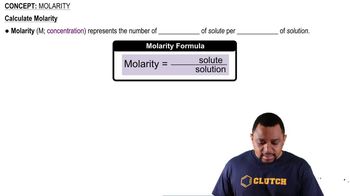
Use the molarity formula: Molarity (M) = moles of solute / liters of solution, to find the volume of Na₂S₂O₃ solution needed.
Rearrange the formula to solve for the volume of the solution: Volume (L) = moles of solute / Molarity (M).
Substitute the given molarity (0.02 M) and the number of moles of Na₂S₂O₃ into the equation.
Convert the volume from liters to milliliters by multiplying by 1000, since 1 L = 1000 mL.
비슷한 문제에 대한 검증된 영상 답변:
이 영상 해법은 위 문제에 도움이 된다고 튜터들이 추천한 것입니다.
영상 길이:
1m
영상 재생:
0 댓글
주요 개념
질문에 올바르게 답하기 위해 반드시 이해해야 하는 핵심 개념들은 다음과 같습니다.
Molarity
Molarity (M) is a measure of concentration defined as the number of moles of solute per liter of solution. It is crucial for understanding how to calculate the amount of a substance in a given volume of solution. In this question, the molarity of sodium thiosulfate (Na₂S₂O₃) is given as 0.02 M, which indicates that there are 0.02 moles of Na₂S₂O₃ in every liter of solution.
Stoichiometry is the area of chemistry that deals with the relationships between the quantities of reactants and products in a chemical reaction. In the provided reaction, the stoichiometric coefficients indicate the molar ratios of the reactants and products, which are essential for determining how many moles of Na₂S₂O₃ are needed to react with a given amount of silver bromide (AgBr).
Volume calculation involves determining the volume of a solution required to achieve a specific number of moles based on its molarity. To find the volume in milliliters (mL) of the 0.02 M Na₂S₂O₃ solution that contains a certain number of moles, the formula used is: Volume (L) = Moles / Molarity. This calculation is essential for practical applications in laboratory settings.