What does it mean when we say that strontium-90, a waste product of nuclear power plants, has a half-life of 28.8 years?
검증된 단계별 안내
1
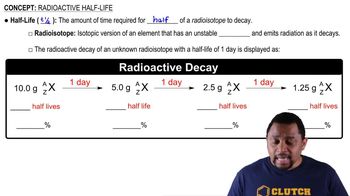
Understand the concept of half-life: The half-life of a radioactive isotope is the time required for half of the radioactive atoms in a sample to decay.
Identify the isotope in question: In this case, it is strontium-90, a radioactive waste product from nuclear power plants.
Relate the half-life to the decay process: A half-life of 28.8 years means that every 28.8 years, half of the strontium-90 atoms in a sample will have decayed into another element or isotope.
Consider the implications: After one half-life (28.8 years), 50% of the original strontium-90 remains. After two half-lives (57.6 years), 25% remains, and so on.
Recognize the environmental impact: Understanding the half-life helps in assessing the long-term environmental and health impacts of strontium-90 as a nuclear waste product.
비슷한 문제에 대한 검증된 영상 답변:
이 영상 해법은 위 문제에 도움이 된다고 튜터들이 추천한 것입니다.
영상 길이:
1m
영상 재생:
0 댓글
주요 개념
질문에 올바르게 답하기 위해 반드시 이해해야 하는 핵심 개념들은 다음과 같습니다.
Half-Life
Half-life is the time required for half of the radioactive atoms in a sample to decay into a more stable form. This concept is crucial in understanding the rate of radioactive decay and helps predict how long it will take for a substance to reduce to a certain level of radioactivity. For strontium-90, a half-life of 28.8 years means that after this period, half of the original amount will have decayed.
Radioactive decay is the process by which unstable atomic nuclei lose energy by emitting radiation. This can occur in various forms, including alpha, beta, and gamma decay. Understanding this process is essential for grasping how radioactive isotopes like strontium-90 transform over time and the implications for safety and environmental impact.
Nuclear waste refers to materials that remain radioactive and hazardous after nuclear reactions, such as those occurring in power plants. Strontium-90 is a byproduct of nuclear fission and poses health risks due to its radioactivity. Understanding the management and decay of nuclear waste is vital for ensuring environmental safety and public health.

 1:27분
1:27분 검증된 단계별 안내
 02:09
02:09