What is the total number of orbitals in the third shell? The fourth shell?
검증된 단계별 안내
1
Understand that the number of orbitals in a shell is determined by the formula: \( n^2 \), where \( n \) is the principal quantum number representing the shell.
For the third shell, set \( n = 3 \). Calculate the number of orbitals using the formula \( n^2 \).
For the fourth shell, set \( n = 4 \). Calculate the number of orbitals using the formula \( n^2 \).
Recognize that each orbital can hold a maximum of 2 electrons, which is useful for understanding electron capacity but not directly needed for this problem.
Summarize the results: The third shell has \( 3^2 \) orbitals, and the fourth shell has \( 4^2 \) orbitals.
비슷한 문제에 대한 검증된 영상 답변:
이 영상 해법은 위 문제에 도움이 된다고 튜터들이 추천한 것입니다.
영상 길이:
3m
영상 재생:
0 댓글
주요 개념
질문에 올바르게 답하기 위해 반드시 이해해야 하는 핵심 개념들은 다음과 같습니다.
Electron Shells
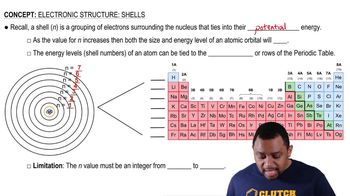
Electron shells are defined energy levels around an atom's nucleus where electrons reside. Each shell is designated by a principal quantum number (n), which indicates its distance from the nucleus. The third shell corresponds to n=3, while the fourth shell corresponds to n=4, with each shell having a specific capacity for electrons.
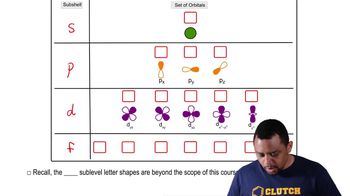
Orbitals are regions within an electron shell where there is a high probability of finding an electron. Each shell contains a set number of orbitals, which can be s, p, d, or f types, each with different shapes and capacities. The total number of orbitals in a shell can be calculated using the formula n^2, where n is the principal quantum number.
To determine the total number of orbitals in a given shell, the formula n^2 is applied. For the third shell (n=3), the total number of orbitals is 3^2 = 9. For the fourth shell (n=4), the total number of orbitals is 4^2 = 16. This calculation is essential for understanding electron configurations and the distribution of electrons in an atom.

 3:58분
3:58분 검증된 단계별 안내
 02:29
02:29