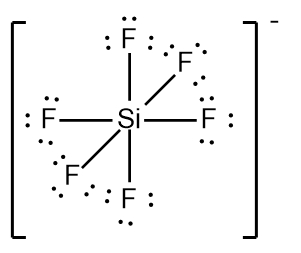
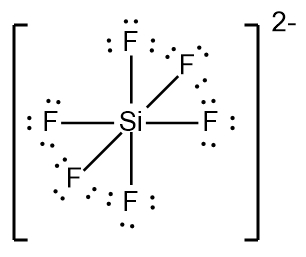
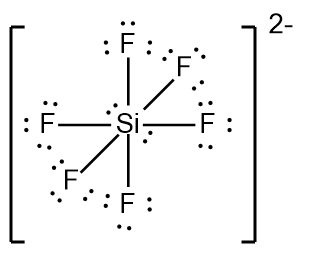
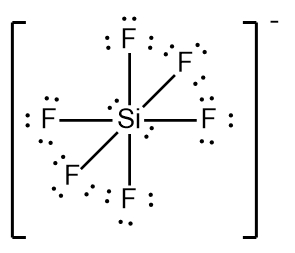
Metalloids can sometimes adopt the bonding preferences of similar nonmetals. Based on your knowledge of expanded octets, draw the Lewis Dot Structure for the following ion, SiF62–.
A
B
C
D
0 댓글
검증된 단계별 안내
1
Identify the central atom in the ion, which is silicon (Si) in this case.
Determine the total number of valence electrons available. Silicon has 4 valence electrons, and each fluorine atom has 7 valence electrons. Since there are 6 fluorine atoms, calculate the total valence electrons from fluorine as 6 * 7 = 42. Add the 2 extra electrons from the 2- charge, giving a total of 4 (from Si) + 42 (from F) + 2 (extra) = 48 valence electrons.
Place the silicon atom in the center and arrange the six fluorine atoms around it. Draw single bonds between the silicon and each fluorine atom. Each bond represents 2 electrons, so 6 bonds use 12 electrons.
Distribute the remaining electrons to satisfy the octet rule for each fluorine atom. Each fluorine needs 8 electrons in total, including the bonding pair. Since each fluorine already has 2 electrons from the bond, place 6 more electrons (3 lone pairs) around each fluorine.
Check the formal charges to ensure the structure is correct. Silicon can have an expanded octet, so it can accommodate more than 8 electrons. Ensure the overall charge of the ion is -2, which is consistent with the given ion SiF6^2-.




 검증된 단계별 안내

