Skip to main content
Introduction to Chemistry
나의 코스
배우기
시험 준비
AI 튜터
학습 가이드
플래시카드
탐험해 보세요
앱을 사용해 보세요
나의 코스
배우기
시험 준비
AI 튜터
학습 가이드
플래시카드
탐험해 보세요
앱을 사용해 보세요
뒤로
Atomic, Ionic and Molecular Solids quiz
카드를 뒤집기 위해 탭할 수 있습니다.
What is the main difference between crystalline and amorphous solids?
카드를 뒤집기 위해 탭할 수 있습니다.
👆
What is the main difference between crystalline and amorphous solids?
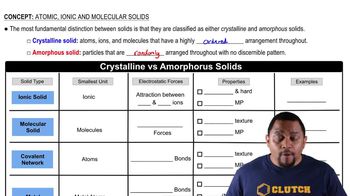
Crystalline solids have highly ordered particle arrangements, while amorphous solids have randomly arranged particles with no discernible pattern.
진행 상황 추적
컨트롤 버튼이 '내비게이션' 모드로 변경되었습니다.
1/15
관련 플래시카드
관련 실천
추천 영상
Atomic, Ionic and Molecular Solids definitions
Atomic, Ionic and Molecular Solids
15 용어
Atomic, Ionic and Molecular Solids
12. Liquids, Solids, and Intermolecular Forces
5 문제점
주제
Heating and Cooling Curves
12. Liquids, Solids, and Intermolecular Forces
5 문제점
주제
12. Liquids, Solids, and Intermolecular Forces
4 주제
12 문제점
장
VideoThumbView.guidedCourse
00:34
Atomic, Ionic and Molecular Solids Example 1
1613
views
7
rank
VideoThumbView.guidedCourse
04:14
Atomic, Ionic and Molecular Solids Concept 1
1906
views
7
rank
이 집합의 용어 (15)
하이드의 정의
What is the main difference between crystalline and amorphous solids?
Crystalline solids have highly ordered particle arrangements, while amorphous solids have randomly arranged particles with no discernible pattern.
What are the four main types of crystalline solids?
The four main types are ionic solids, molecular solids, covalent network solids, and metals.
What is the smallest unit in an ionic solid?
The smallest unit in an ionic solid is the ion, specifically a cation and an anion.
What type of electrostatic force holds ionic solids together?
Ionic solids are held together by electrostatic attraction between positive and negative ions.
List two properties of ionic solids.
Ionic solids are typically brittle and hard, and they have high melting points.
Give an example of an ionic solid.
A common example of an ionic solid is sodium chloride (NaCl).
What is the smallest unit in a molecular solid?
The smallest unit in a molecular solid is the molecule.
What type of forces hold molecular solids together?
Molecular solids are held together by intermolecular forces.
Describe the texture and melting point of molecular solids.
Molecular solids are generally soft and have low to moderate melting points.
What is an example of a molecular solid?
Ice (solid H2O) is an example of a molecular solid.
What is the smallest unit in a covalent network solid?
The smallest unit in a covalent network solid is the atom.
What are the properties of covalent network solids?
Covalent network solids are very hard and have very high melting points.
Name a common example of a covalent network solid.
Diamond, a form of carbon, is a common example of a covalent network solid.
What is unique about the melting point and flow of amorphous solids?
Amorphous solids do not have a distinct melting point and can flow, which is unusual for solids.
Give two examples of amorphous solids.
Glass and tar are examples of amorphous solids.
 뒤로뒤로
뒤로뒤로
 00:34
00:34