Skip to main content
Introduction to Chemistry
나의 코스
배우기
시험 준비
AI 튜터
학습 가이드
플래시카드
탐험해 보세요
앱을 사용해 보세요
나의 코스
배우기
시험 준비
AI 튜터
학습 가이드
플래시카드
탐험해 보세요
앱을 사용해 보세요
뒤로
Atomic Theory definitions
카드를 뒤집기 위해 탭할 수 있습니다.
Atom
카드를 뒤집기 위해 탭할 수 있습니다.
👆
Atom
Smallest unit of matter retaining chemical properties, once thought indivisible but now known to contain subatomic particles.
진행 상황 추적
컨트롤 버튼이 '내비게이션' 모드로 변경되었습니다.
1/15
관련 플래시카드
관련 실천
추천 영상
Atomic Theory quiz #1
Atomic Theory
20 용어
Atomic Theory
4. Atoms and Elements
5 문제점
주제
Rutherford Gold Foil Experiment
4. Atoms and Elements
2 문제점
주제
4. Atoms and Elements - Part 1 of 2
12 주제
34 문제점
장
4. Atoms and Elements - Part 2 of 2
1 주제
3 문제점
장
VideoThumbView.guidedCourse
05:22
Atomic Theory
9441
views
88
rank
VideoThumbView.guidedCourse
01:48
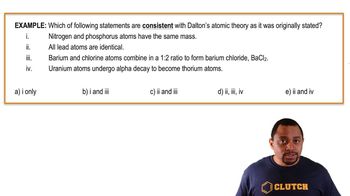
Atomic Theory Example 1
7652
views
57
rank
이 집합의 용어 (15)
하이드의 정의
Atom
Smallest unit of matter retaining chemical properties, once thought indivisible but now known to contain subatomic particles.
Atomic Theory
Scientific explanation describing the nature, behavior, and structure of matter at the atomic level.
Democritus
Ancient Greek philosopher who first proposed the existence of indivisible particles making up matter.
John Dalton
Early 19th-century scientist who formulated foundational principles about the composition and behavior of atoms.
Postulate
Fundamental assumption or principle forming the basis of a scientific theory, such as those in Dalton’s model.
Subatomic Particle
Component found within atoms, including protons, neutrons, and electrons, not known in Dalton’s era.
Proton
Positively charged particle located in the nucleus, determining the atomic number of an element.
Neutron
Electrically neutral particle in the atomic nucleus, contributing to atomic mass and isotope formation.
Electron
Negatively charged particle orbiting the nucleus, responsible for chemical bonding and reactivity.
Isotope
Variant of an element’s atom with the same number of protons but different numbers of neutrons.
Compound
Substance formed from two or more different atoms chemically combined in specific ratios.
Chemical Reaction
Process involving the rearrangement of atoms, resulting in new substances without creating or destroying matter.
Conservation of Mass
Principle stating that matter cannot be created or destroyed, only transformed during chemical changes.
Element
Pure substance consisting of only one type of atom, defined by its number of protons.
Mass Number
Sum of protons and neutrons in an atom’s nucleus, distinguishing isotopes of the same element.
 뒤로뒤로
뒤로뒤로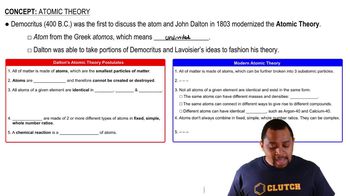
 05:22
05:22