Skip to main content
Introduction to Chemistry
나의 코스
배우기
시험 준비
AI 튜터
학습 가이드
플래시카드
탐험해 보세요
앱을 사용해 보세요
나의 코스
배우기
시험 준비
AI 튜터
학습 가이드
플래시카드
탐험해 보세요
앱을 사용해 보세요
뒤로
Chemistry Gas Laws definitions
카드를 뒤집기 위해 탭할 수 있습니다.
Ideal Gas Law
카드를 뒤집기 위해 탭할 수 있습니다.
👆
Ideal Gas Law
A mathematical relationship connecting pressure, volume, temperature, and moles of a gas using the equation PV = nRT.
진행 상황 추적
컨트롤 버튼이 '내비게이션' 모드로 변경되었습니다.
1/14
관련 플래시카드
관련 실천
추천 영상
Chemistry Gas Laws quiz
Chemistry Gas Laws
15 용어
Chemistry Gas Laws
11 Gases
5 문제점
주제
Chemistry Gas Laws: Combined Gas Law
11 Gases
5 문제점
주제
11 Gases
10 주제
26 문제점
장
VideoThumbView.guidedCourse
03:20
Chemistry Gas Laws
5829
views
55
rank
VideoThumbView.guidedCourse
01:14
Chemistry Gas Laws Example 1
5413
views
43
rank
VideoThumbView.guidedCourse
02:06
Chemistry Gas Laws
5446
views
38
rank
이 집합의 용어 (14)
하이드의 정의
Ideal Gas Law
A mathematical relationship connecting pressure, volume, temperature, and moles of a gas using the equation PV = nRT.
Boyle's Law
A principle stating that pressure and volume of a gas are inversely proportional when temperature and moles are constant.
Gay-Lussac's Law
A rule describing flexibly that pressure and temperature of a gas are directly proportional at constant volume and moles.
Avogadro's Law
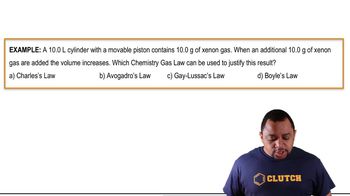
A statement that volume and moles of a gas are directly proportional when pressure and temperature are constant.
Charles's Law
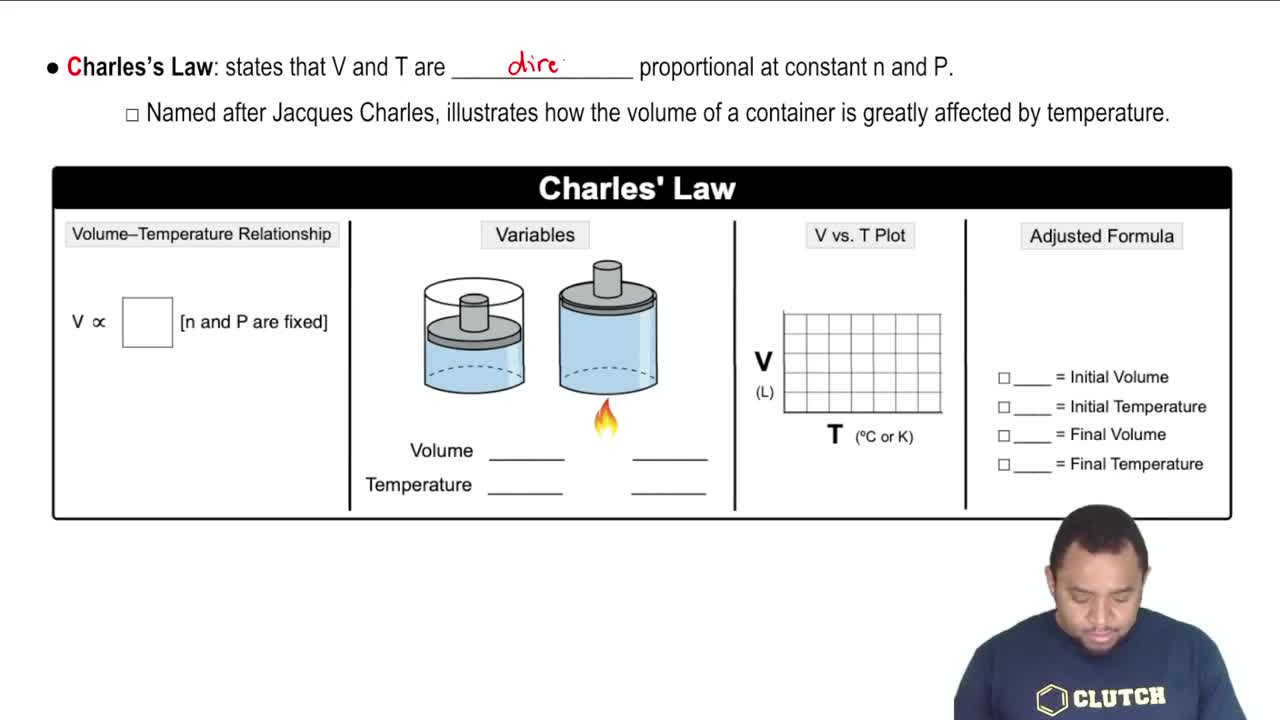
A law indicating that volume and temperature of a gas are directly proportional at constant pressure and moles.
Pressure
The force exerted by gas particles per unit area on the walls of a container, often measured in atmospheres or pascals.
Volume
The amount of three-dimensional space occupied by a gas, typically measured in liters or milliliters.
Temperature
A measure of the average kinetic energy of gas particles, required in Kelvin for gas law calculations.
Moles
A unit representing the amount of substance, specifically the number of particles present in a gas sample.
Kelvin
The SI unit for temperature, used in gas law equations to ensure direct proportionality relationships.
Direct Proportionality
A relationship where two variables increase or decrease together, shown as a straight line on a graph.
Inverse Proportionality
A relationship where one variable increases as the other decreases, depicted as a downward curve on a graph.
Movable Piston
A device in a container allowing volume changes, used to illustrate gas law relationships in visual examples.
Adjusted Formula
A rearranged equation derived from the ideal gas law, tailored to specific variable relationships in each gas law.
 뒤로뒤로
뒤로뒤로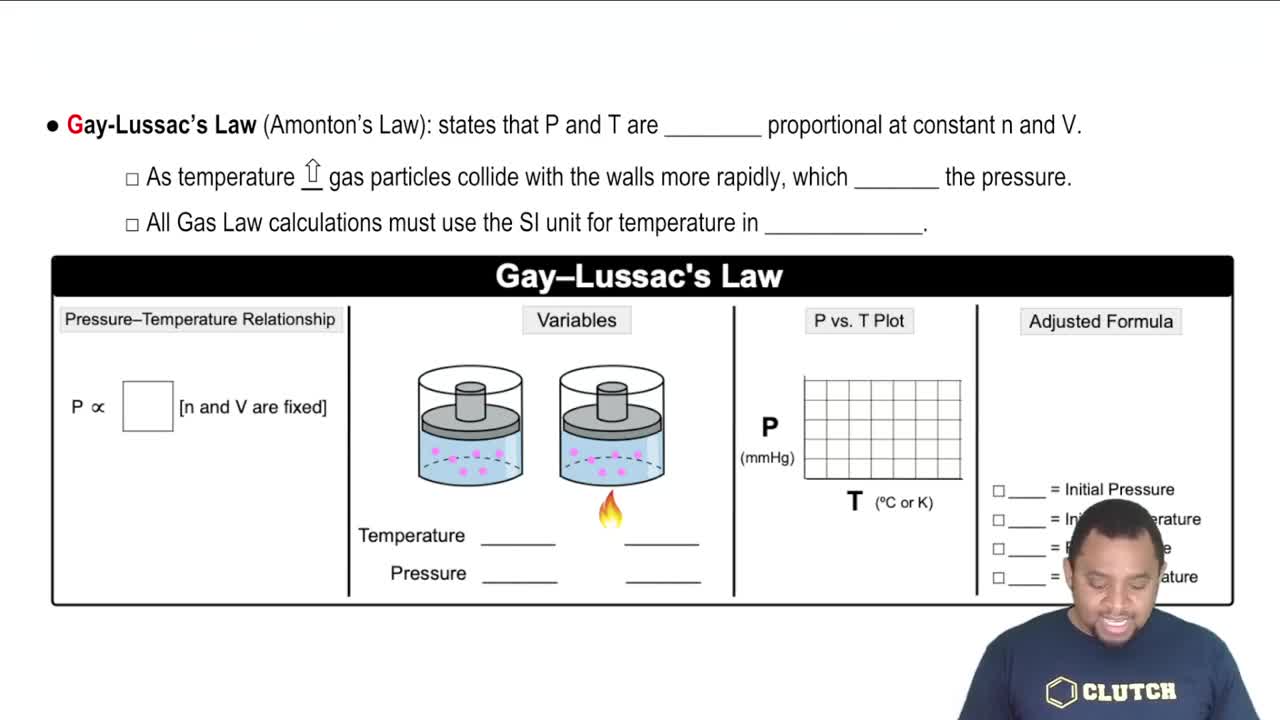
 03:20
03:20