Skip to main content
Introduction to Chemistry
나의 코스
배우기
시험 준비
AI 튜터
학습 가이드
플래시카드
탐험해 보세요
앱을 사용해 보세요
나의 코스
배우기
시험 준비
AI 튜터
학습 가이드
플래시카드
탐험해 보세요
앱을 사용해 보세요
뒤로
Energy Diagrams definitions
카드를 뒤집기 위해 탭할 수 있습니다.
Energy Diagram
카드를 뒤집기 위해 탭할 수 있습니다.
👆
Energy Diagram
A curved plot showing energy changes of reactants, products, and the highest energy point during a chemical reaction.
진행 상황 추적
컨트롤 버튼이 '내비게이션' 모드로 변경되었습니다.
1/15
관련 플래시카드
관련 실천
추천 영상
Energy Diagrams quiz
Energy Diagrams
15 용어
Energy Diagrams
15. Chemical Equilibrium
5 문제점
주제
Chemical Equilibrium
15. Chemical Equilibrium
5 문제점
주제
15. Chemical Equilibrium
6 주제
16 문제점
장
VideoThumbView.guidedCourse
02:40
Energy Diagrams Concept 1
3461
views
11
rank
VideoThumbView.guidedCourse
00:43
Energy Diagrams Example 2
3468
views
9
rank
VideoThumbView.guidedCourse
02:23
Energy Diagrams Concept 2
3597
views
10
rank
이 집합의 용어 (15)
하이드의 정의
Energy Diagram
A curved plot showing energy changes of reactants, products, and the highest energy point during a chemical reaction.
Reactant
A starting substance in a chemical reaction, represented at the enough-left side of an energy diagram.
Product
A substance formed at the end of a chemical reaction, shown at the far-right side of an energy diagram.
Transition State
The maximum energy structure between reactants and products, located at the characteristic peak of an energy diagram.
Activated Complex
A fleeting, high-energy arrangement of atoms at the top of the energy curve, identical to the transition state.
Reaction Coordinate
The x-axis of an energy diagram, representing the progress or lifetime of a chemical reaction.
Activation Energy
The minimum energy difference between reactants and the transition state, determining how fast a reaction proceeds.
Energy Barrier
Another term for the minimum energy required to convert reactants into products, equal to activation energy.
Overall Energy Change
The difference in energy between products and reactants, indicating reaction favorability and stability.
Enthalpy
A measure of thermal energy change during a reaction, with negative values indicating heat release.
Gibbs Free Energy
A value indicating the favorability of product formation; negative values mean a reaction is spontaneous.
Exothermic Reaction
A process where thermal energy is released, resulting in products with lower energy than reactants.
Endothermic Reaction
A process where thermal energy is absorbed, resulting in products with higher energy than reactants.
Exergonic Reaction
A reaction with a negative Gibbs free energy, favoring product formation and greater stability.
Endergonic Reaction
A reaction with a positive Gibbs free energy, not favoring product formation and resulting in less stability.
 뒤로뒤로
뒤로뒤로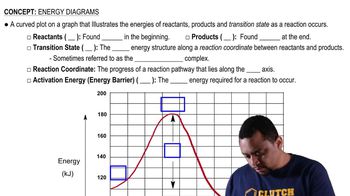
 02:40
02:40