Skip to main content
Introduction to Chemistry
나의 코스
배우기
시험 준비
AI 튜터
학습 가이드
플래시카드
탐험해 보세요
앱을 사용해 보세요
나의 코스
배우기
시험 준비
AI 튜터
학습 가이드
플래시카드
탐험해 보세요
앱을 사용해 보세요
뒤로
Naming Monoatomic Cations definitions
카드를 뒤집기 위해 탭할 수 있습니다.
Cation
카드를 뒤집기 위해 탭할 수 있습니다.
👆
Cation
A positively charged ion formed when an atom loses one or more electrons, often a metal in ionic compounds.
진행 상황 추적
컨트롤 버튼이 '내비게이션' 모드로 변경되었습니다.
1/15
관련 플래시카드
관련 실천
추천 영상
Naming Monoatomic Cations quiz
Naming Monoatomic Cations
15 용어
Naming Monoatomic Cations
5. Molecules and Compounds
5 문제점
주제
Naming Monoatomic Anions
5. Molecules and Compounds
5 문제점
주제
5. Molecules and Compounds
11 주제
32 문제점
장
VideoThumbView.guidedCourse
00:34
Naming Monoatomic Cations Example 1
5152
views
41
rank
1
comments
VideoThumbView.guidedCourse
01:24
Naming Monoatomic Cations Concept 1
5525
views
45
rank
VideoThumbView.guidedCourse
03:28
Naming Monoatomic Cations Concept 2
4268
views
32
rank
이 집합의 용어 (15)
하이드의 정의
Cation
A positively charged ion formed when an atom loses one or more electrons, often a metal in ionic compounds.
Roman Numeral
A symbol placed in parentheses after a metal's name to indicate its specific positive charge when multiple charges are possible.
Systematic Name
A naming method using the element's name followed by a Roman numeral and 'ion' to specify the charge.
Common Name
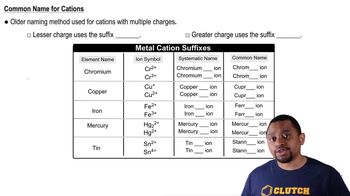
A traditional naming method for metal ions with multiple charges, often using Latin roots and specific suffixes.
Suffix
An ending added to a cation's name, such as '-ous' for lower charge and '-ic' for higher charge in the common naming system.
Group 1A
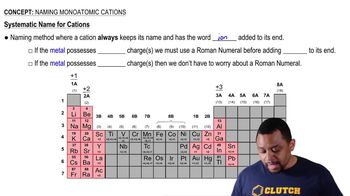
A vertical column in the periodic table containing metals with a fixed +1 charge, not requiring Roman numerals in their names.
Group 2A
A vertical column in the periodic table containing metals with a fixed +2 charge, named without Roman numerals.
Group 3A
A vertical column in the periodic table containing metals with a fixed +3 charge, named without Roman numerals.
Latin Root
The origin of some element symbols and common names, reflecting historical or traditional language influences.
Chromous Ion
A chromium ion with a +2 charge, named using the '-ous' suffix to indicate the lower oxidation state.
Chromic Ion
A chromium ion with a +3 charge, named using the '-ic' suffix to indicate the higher oxidation state.
Cuprous Ion
A copper ion with a +1 charge, named with the '-ous' suffix and derived from the Latin root for copper.
Cupric Ion
A copper ion with a +2 charge, named with the '-ic' suffix and based on the Latin root for copper.
Ferrous Ion
An iron ion with a +2 charge, named with the '-ous' suffix and based on the Latin root for iron.
Ferric Ion
An iron ion with a +3 charge, named with the '-ic' suffix and based on the Latin root for iron.
 뒤로뒤로
뒤로뒤로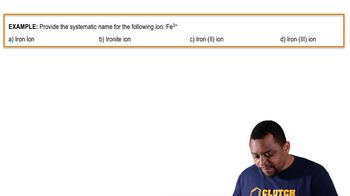
 00:34
00:34