Skip to main content
Introduction to Chemistry
나의 코스
배우기
시험 준비
AI 튜터
학습 가이드
플래시카드
탐험해 보세요
앱을 사용해 보세요
나의 코스
배우기
시험 준비
AI 튜터
학습 가이드
플래시카드
탐험해 보세요
앱을 사용해 보세요
뒤로
Polyatomic Ions quiz
카드를 뒤집기 위해 탭할 수 있습니다.
What is a polyatomic ion?
카드를 뒤집기 위해 탭할 수 있습니다.
👆
What is a polyatomic ion?
A polyatomic ion is a tightly bound group of different elements with an overall charge, either positive or negative.
진행 상황 추적
컨트롤 버튼이 '내비게이션' 모드로 변경되었습니다.
1/15
관련 플래시카드
관련 실천
추천 영상
Polyatomic Ions definitions
Polyatomic Ions
15 용어
Polyatomic Ions
5. Molecules and Compounds
5 문제점
주제
Naming Ionic Compounds
5. Molecules and Compounds
5 문제점
주제
5. Molecules and Compounds
11 주제
32 문제점
장
VideoThumbView.guidedCourse
01:16
Polyatomic Ions
8768
views
69
rank
VideoThumbView.guidedCourse
01:08
Polyatomic Ions Example 3
7721
views
57
rank
VideoThumbView.guidedCourse
01:26
Polyatomic Ions
11081
views
110
rank
1
comments
이 집합의 용어 (15)
하이드의 정의
What is a polyatomic ion?
A polyatomic ion is a tightly bound group of different elements with an overall charge, either positive or negative.
What distinguishes polyatomic oxyanions from other polyatomic ions?
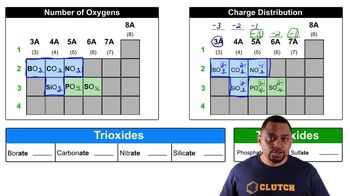
Polyatomic oxyanions are negatively charged ions that contain oxygen and are named based on the number of oxygens present.
How many oxygens are in a trioxide polyatomic ion, and what suffix is used in its name?
Trioxide polyatomic ions have 3 oxygens and their names end with 'ate'.
How many oxygens are in a tetraoxide polyatomic ion, and what suffix is used in its name?
Tetraoxide polyatomic ions have 4 oxygens and their names end with 'ate'.
What are the charges for trioxides and tetraoxides based on their position in the periodic table?
Trioxides typically have charges of -3, -2, or -1, while tetraoxides have charges of -3 or -2.
Name the common trioxide polyatomic ions and their formulas.
Common trioxides are borate (BO3^3-), carbonate (CO3^2-), nitrate (NO3^-), and silicate (SiO3^2-).
Name the common tetraoxide polyatomic ions and their formulas.
Common tetraoxides are phosphate (PO4^3-) and sulfate (SO4^2-).
What happens to the name and charge of a polyatomic ion when the number of oxygens is decreased by one?
The ending changes from 'ate' to 'ite', but the charge remains the same.
What is the formula and charge for sulfite, and how is it related to sulfate?
Sulfite is SO3^2-, formed by removing one oxygen from sulfate (SO4^2-) while keeping the charge unchanged.
What is the common charge for halogen oxyanions (oxyhalogens), and how are their names determined?
Halogen oxyanions all have a -1 charge, and their names use prefixes and suffixes based on the number of oxygens.
What prefix and suffix are used for a halogen oxyanion with four oxygens?
The prefix 'per-' and the suffix '-ate' are used, as in 'perbromate' for BrO4^-.
What are the only major positively charged polyatomic ions, and their formulas?
The only major positively charged polyatomic ions are ammonium (NH4^+) and mercury(I) (Hg2^2+).
Name three polyatomic ions that do not fit predictable patterns and must be memorized.
Permanganate (MnO4^-), chromate (CrO4^2-), and oxalate (C2O4^2-) must be memorized.
List three additional polyatomic ions and their formulas.
Cyanide (CN^-), hydroxide (OH^-), and acetate (C2H3O2^- or CH3COO^-).
How does the formula for cyanate differ from cyanide?
Cyanate is OCN^- (contains oxygen), while cyanide is CN^- (does not contain oxygen).
 뒤로뒤로
뒤로뒤로
 01:16
01:16