Skip to main content
Introduction to Chemistry
나의 코스
배우기
시험 준비
AI 튜터
학습 가이드
플래시카드
탐험해 보세요
앱을 사용해 보세요
나의 코스
배우기
시험 준비
AI 튜터
학습 가이드
플래시카드
탐험해 보세요
앱을 사용해 보세요
뒤로
Solubility Rules definitions
카드를 뒤집기 위해 탭할 수 있습니다.
Solubility
카드를 뒤집기 위해 탭할 수 있습니다.
👆
Solubility
A chemical property describing how much of a substance can dissolve in a solvent to form a homogeneous mixture.
진행 상황 추적
컨트롤 버튼이 '내비게이션' 모드로 변경되었습니다.
1/15
관련 플래시카드
관련 실천
추천 영상
Solubility Rules quiz #1
Solubility Rules
10 용어
Solubility Rules
7. Chemical Reactions
5 문제점
주제
Electrolytes (Simplified)
7. Chemical Reactions
5 문제점
주제
7. Chemical Reactions
8 주제
24 문제점
장
VideoThumbView.guidedCourse
00:28
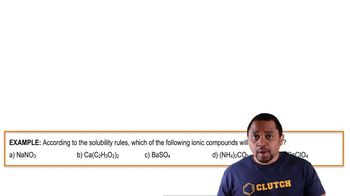
Solubility Rules
9621
views
46
rank
VideoThumbView.guidedCourse
01:32
Solubility Rules Example 2
8540
views
74
rank
VideoThumbView.guidedCourse
02:30
Solubility Rules
10015
views
85
rank
이 집합의 용어 (15)
하이드의 정의
Solubility
A chemical property describing how much of a substance can dissolve in a solvent to form a homogeneous mixture.
Solute
A substance that is dissolved in a solvent, often breaking into ions if soluble.
Solvent
A medium, typically a liquid like water, in which other substances are dissolved.
Solution
A uniform mixture formed when a solute dissolves completely in a solvent.
Aqueous Ion
A charged particle surrounded by water molecules after a soluble compound dissociates.
Precipitate
A solid formed when an insoluble compound results from mixing solutions.
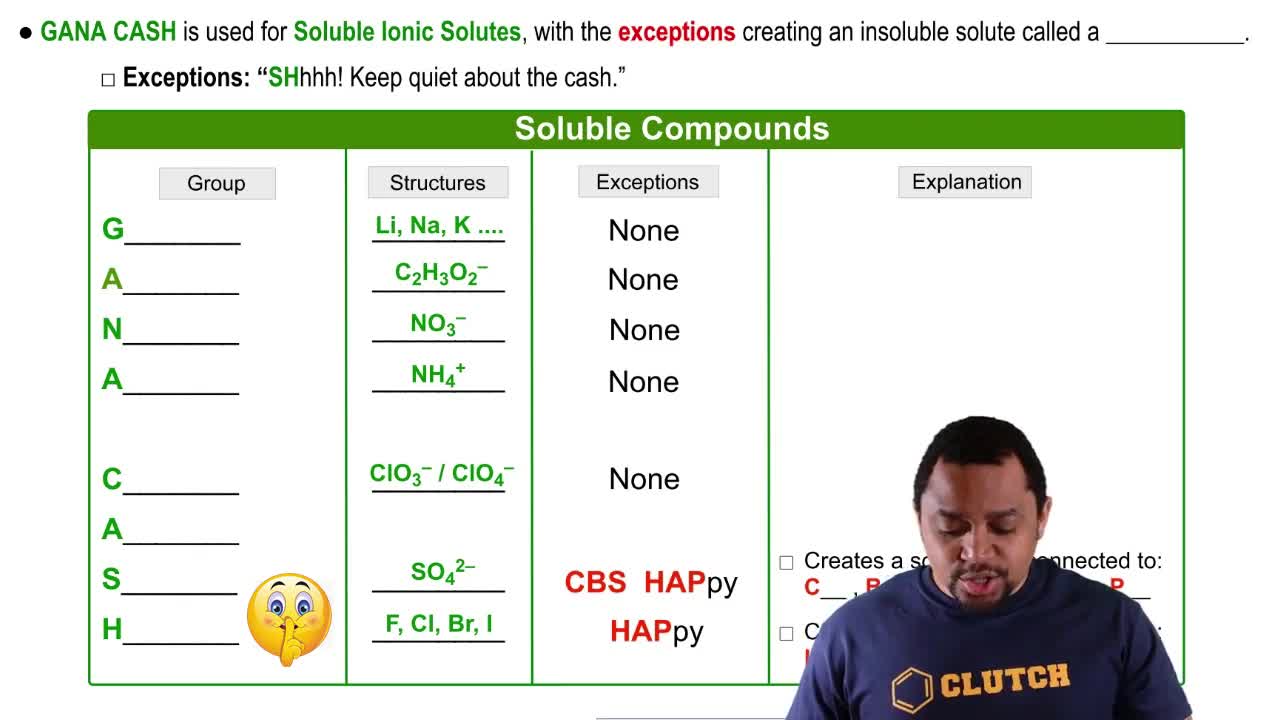
Group 1A Elements
Alkali metals like sodium and potassium, whose compounds are always soluble in water.
Acetate
An ion, C2H3O2−, whose compounds are generally soluble with no exceptions.
Nitrate
An ion, NO3−, that forms soluble compounds without exceptions.
Ammonium
A polyatomic ion, NH4+, that ensures solubility when present in ionic compounds.
Halogens
Group 7A elements like chlorine and bromine, usually forming soluble salts except with silver, lead, or mercury.
Sulfate
An ion, SO4^2−, forming soluble salts except with calcium, barium, strontium, silver, or lead.
Carbonate
An ion, CO3^2−, whose compounds are generally insoluble except with Group 1A or ammonium.
Hydroxide
An ion, OH−, usually forming insoluble compounds except with calcium, barium, or strontium.
Phosphate
An ion, PO4^3−, typically resulting in insoluble compounds unless paired with Group 1A or ammonium.
 뒤로뒤로
뒤로뒤로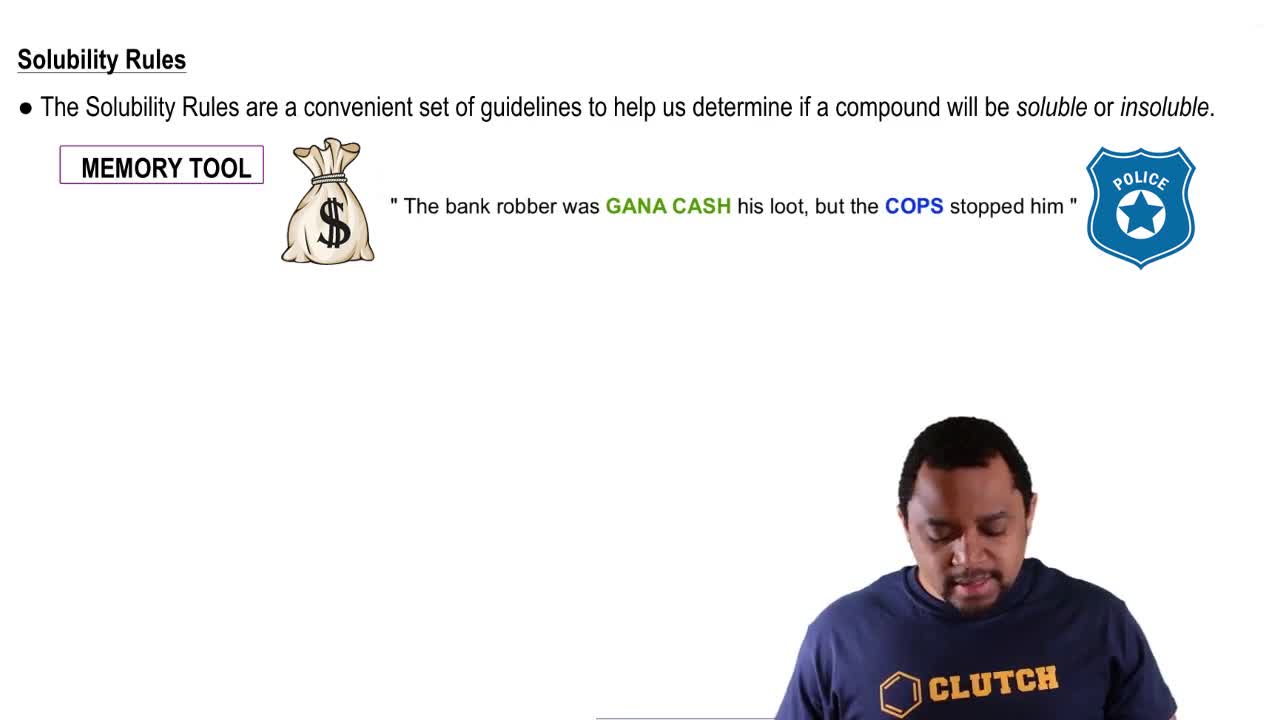
 00:28
00:28