Skip to main content
Introduction to Chemistry
나의 코스
배우기
시험 준비
AI 튜터
학습 가이드
플래시카드
탐험해 보세요
앱을 사용해 보세요
나의 코스
배우기
시험 준비
AI 튜터
학습 가이드
플래시카드
탐험해 보세요
앱을 사용해 보세요
뒤로
Solutions: Mass Percent quiz
카드를 뒤집기 위해 탭할 수 있습니다.
What is the formula for calculating mass percent in a solution?
카드를 뒤집기 위해 탭할 수 있습니다.
👆
What is the formula for calculating mass percent in a solution?
Mass percent = (mass of solute / total mass of solution) × 100.
진행 상황 추적
컨트롤 버튼이 '내비게이션' 모드로 변경되었습니다.
1/15
관련 플래시카드
관련 실천
추천 영상
Solutions: Mass Percent definitions
Solutions: Mass Percent
12 용어
Solutions: Mass Percent
13. Solutions
5 문제점
주제
Molarity
13. Solutions
5 문제점
주제
13. Solutions - Part 1 of 2
12 주제
35 문제점
장
13. Solutions - Part 2 of 2
2 주제
6 문제점
장
VideoThumbView.guidedCourse
01:29
Solutions: Mass Percent Concept 1
3700
views
10
rank
VideoThumbView.guidedCourse
01:45
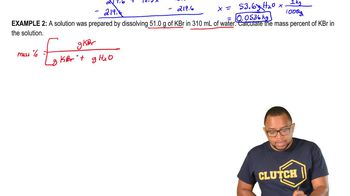
Solutions: Mass Percent Example 2
3442
views
19
rank
VideoThumbView.guidedCourse
03:14
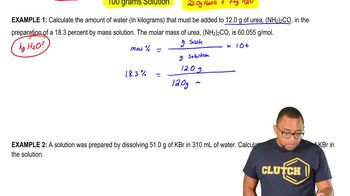
Solutions: Mass Percent Example 1
4094
views
11
rank
이 집합의 용어 (15)
하이드의 정의
What is the formula for calculating mass percent in a solution?
Mass percent = (mass of solute / total mass of solution) × 100.
In a 23% NaOH solution, how many grams of NaOH are present in 100 grams of solution?
There are 23 grams of NaOH in 100 grams of solution.
What does the total mass of a solution consist of?
The total mass of a solution is the sum of the solute and solvent masses.
How do you find the mass of the solvent in a 23% NaOH solution with 100 grams total mass?
Subtract the mass of NaOH (23 g) from the total mass (100 g) to get 77 grams of solvent.
What does 'mass percent' indicate about the composition of a solution?
Mass percent shows the proportion of solute in the total mass of the solution.
If a solution is described as 23% NaOH, what does the percentage refer to?
It refers to 23 grams of NaOH per 100 grams of solution.
Why do we assume 100 grams of solution when calculating mass percent?
Because percentages are based on a total of 100, making calculations straightforward.
How can mass percent be broken down in terms of solute and solvent?
Mass percent can be expressed as the mass of solute divided by the sum of solute and solvent masses, times 100.
What is the mass of the solvent in a solution if the solute is 23 grams and the total solution is 100 grams?
The mass of the solvent is 77 grams (100 g - 23 g).
What is the importance of understanding solute and solvent breakdown in mass percent calculations?
It helps accurately solve problems involving the composition of solutions.
What is the mass percent of NaOH if there are 23 grams of NaOH in 100 grams of solution?
The mass percent is 23%.
How do you calculate the mass percent if you know the masses of solute and solvent?
Add the masses to get total solution mass, then divide solute mass by total mass and multiply by 100.
What is the mass percent formula expanded for solute and solvent?
Mass percent = (mass of solute / (mass of solute + mass of solvent)) × 100.
If a solution contains 23 grams of NaOH and 77 grams of solvent, what is the total mass?
The total mass is 100 grams (23 g + 77 g).
Why is it important to distinguish between solute and solvent in mass percent problems?
Distinguishing helps clarify the calculation and ensures correct interpretation of solution composition.
 뒤로뒤로
뒤로뒤로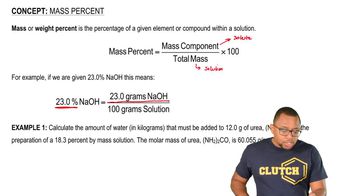
 01:29
01:29