Skip to main content
Introduction to Chemistry
나의 코스
배우기
시험 준비
AI 튜터
학습 가이드
플래시카드
탐험해 보세요
앱을 사용해 보세요
나의 코스
배우기
시험 준비
AI 튜터
학습 가이드
플래시카드
탐험해 보세요
앱을 사용해 보세요
뒤로
The Ideal Gas Law Derivations definitions
카드를 뒤집기 위해 탭할 수 있습니다.
Ideal Gas Law
카드를 뒤집기 위해 탭할 수 있습니다.
👆
Ideal Gas Law
A mathematical relationship connecting pressure, volume, moles, and temperature for a gas under ideal conditions.
진행 상황 추적
컨트롤 버튼이 '내비게이션' 모드로 변경되었습니다.
1/13
관련 플래시카드
관련 실천
추천 영상
The Ideal Gas Law Derivations quiz
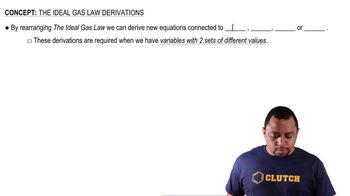
The Ideal Gas Law Derivations
15 용어
The Ideal Gas Law Derivations
11 Gases
3 문제점
주제
The Ideal Gas Law Applications
11 Gases
5 문제점
주제
11 Gases
10 주제
26 문제점
장
VideoThumbView.guidedCourse
04:51
The Ideal Gas Law Derivations Example
28
views
VideoThumbView.guidedCourse
00:47
The Ideal Gas Law Derivations
7949
views
34
rank
2
comments
이 집합의 용어 (13)
하이드의 정의
Ideal Gas Law
A mathematical relationship connecting pressure, volume, moles, and temperature for a gas under ideal conditions.
Pressure
A measure of the force exerted by gas particles per unit area on the walls of a container.
Volume
The amount of three-dimensional space occupied by a gas sample, often measured in liters.
Moles
A unit representing the quantity of gas particles, allowing comparison between different substances.
Temperature
A measure of the average kinetic energy of gas particles, typically expressed in Kelvin.
Derivation
A process of rearranging an equation to create new forms suited for specific variable changes.
Variable
A symbol or quantity in an equation that can represent different values in a problem.
Equation
A mathematical statement showing the relationship between different physical quantities.
Condition
A set of values for pressure, volume, moles, or temperature specified in a problem scenario.
Set
A group of values for a variable, such as initial and final states in a gas law problem.
Scenario
A described situation in a problem where specific values for gas properties are given or changed.
Relationship
A connection or dependency between physical quantities, such as how pressure changes with volume.
Rearrangement
An algebraic manipulation of an equation to isolate or combine variables as needed for a problem.
 뒤로뒤로
뒤로뒤로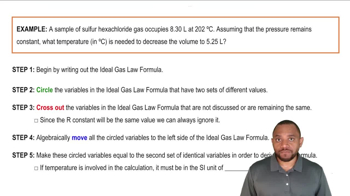
 04:51
04:51