Skip to main content
Introduction to Chemistry
나의 코스
배우기
시험 준비
AI 튜터
학습 가이드
플래시카드
탐험해 보세요
앱을 사용해 보세요
나의 코스
배우기
시험 준비
AI 튜터
학습 가이드
플래시카드
탐험해 보세요
앱을 사용해 보세요
뒤로
The Ideal Gas Law quiz
카드를 뒤집기 위해 탭할 수 있습니다.
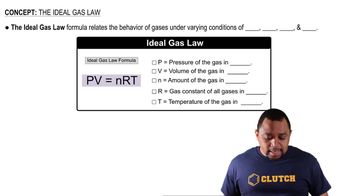
What is the formula for the ideal gas law?
카드를 뒤집기 위해 탭할 수 있습니다.
👆
What is the formula for the ideal gas law?
The formula is PV = nRT, where P is pressure, V is volume, n is moles, R is the gas constant, and T is temperature.
진행 상황 추적
컨트롤 버튼이 '내비게이션' 모드로 변경되었습니다.
1/15
관련 플래시카드
관련 실천
추천 영상
The Ideal Gas Law definitions
The Ideal Gas Law
14 용어
The Ideal Gas Law
11 Gases
5 문제점
주제
The Ideal Gas Law Derivations
11 Gases
3 문제점
주제
11 Gases
10 주제
26 문제점
장
VideoThumbView.guidedCourse
02:58
The Ideal Gas Law Example 1
10107
views
85
rank
VideoThumbView.guidedCourse
01:15
The Ideal Gas Law
10976
views
98
rank
VideoThumbView.guidedCourse
01:56
The Ideal Gas Law
8894
views
50
rank
이 집합의 용어 (15)
하이드의 정의
What is the formula for the ideal gas law?
The formula is PV = nRT, where P is pressure, V is volume, n is moles, R is the gas constant, and T is temperature.
What units are used for pressure in the ideal gas law?
Pressure is measured in atmospheres (atm) when using the ideal gas law.
What units are used for volume in the ideal gas law?
Volume is measured in liters (L) in the ideal gas law.
What does 'n' represent in the ideal gas law equation?
'n' represents the amount of gas in moles.
What is the typical value of the gas constant R for the ideal gas law?
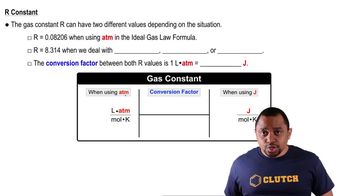
R is typically 0.08206 liters·atmospheres/(mole·Kelvin) for the ideal gas law.
What units are used for temperature in the ideal gas law?
Temperature is measured in Kelvins (K) in the ideal gas law.
When do you use the value 8.314 for the gas constant R?
Use 8.314 joules/(mole·Kelvin) for R when dealing with speed, velocity, or energy calculations.
What is the conversion factor between liters·atmospheres and joules?
1 liter·atmosphere equals 101.325 joules.
How do you convert R from 0.08206 to 8.314?
Multiply 0.08206 by 101.325 to cancel out liters·atmospheres and convert to joules, resulting in 8.314.
Why is it important to memorize the ideal gas law formula?
Professors expect you to know it, and it is used in many calculations throughout the chapter.
What happens to the units of R when converting for energy calculations?
The units change from liters·atmospheres/(mole·Kelvin) to joules/(mole·Kelvin).
What value of R should you use for calculations involving the ideal gas law?
Use R = 0.08206 liters·atmospheres/(mole·Kelvin) for ideal gas law calculations.
What value of R should you use for calculations involving energy?
Use R = 8.314 joules/(mole·Kelvin) for energy-related calculations.
What is the significance of the conversion factor 101.325 in gas law calculations?
It allows conversion between liters·atmospheres and joules, which is necessary for energy calculations.
What are the four variables related in the ideal gas law?
The four variables are pressure (P), volume (V), moles (n), and temperature (T).
 뒤로뒤로
뒤로뒤로
 02:58
02:58