 뒤로
뒤로Conversion Factors in Introduction to Chemistry
 03:45
03:45
이 집합의 용어 (20)
A conversion factor is a ratio used to convert a quantity from one unit to another, based on the equality between two different units.
Multiply the original quantity by a conversion factor that relates the original unit to the desired unit, ensuring units cancel properly.
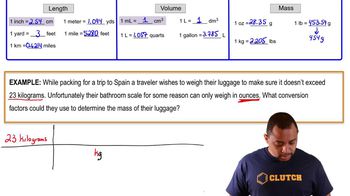
1 inch = 2.54 centimeters, so the conversion factor can be \(\frac{2.54\ \text{cm}}{1\ \text{inch}}\) or \(\frac{1\ \text{inch}}{2.54\ \text{cm}}\).
Because they represent the same quantity in different units, so multiplying by them does not change the value, only the units.
Identify the given quantity and the units you want to convert to.
Arrange the conversion factor so that the unit you want to cancel is opposite the given unit, allowing it to divide out.
Dimensional analysis is the process of using conversion factors to convert units and check that units cancel correctly.
Use \(\frac{1000\ \text{m}}{1\ \text{km}}\): 5 km × \(\frac{1000\ \text{m}}{1\ \text{km}}\) = 5000 m.
1 kilogram = 1000 grams, so conversion factors are \(\frac{1000\ \text{g}}{1\ \text{kg}}\) or \(\frac{1\ \text{kg}}{1000\ \text{g}}\).
Use \(\frac{1\ \text{L}}{1000\ \text{mL}}\): 2500 mL × \(\frac{1\ \text{L}}{1000\ \text{mL}}\) = 2.5 L.
Ensuring units are consistent allows accurate calculations and meaningful results.
Verify that all unwanted units cancel and the final units match the desired units.
Use \(\frac{1\ \text{hour}}{60\ \text{minutes}}\): 60 min × \(\frac{1\ \text{hour}}{60\ \text{minutes}}\) = 1 hour.
1 pound ≈ 0.4536 kilograms, so conversion factors are \(\frac{0.4536\ \text{kg}}{1\ \text{lb}}\) or \(\frac{1\ \text{lb}}{0.4536\ \text{kg}}\).
Exact conversion factors reduce rounding errors and increase calculation accuracy.
Use \(\frac{60\ \text{min}}{1\ \text{hour}}\) and \(\frac{60\ \text{sec}}{1\ \text{min}}\): 3.5 h × \(\frac{60\ \text{min}}{1\ \text{h}}\) × \(\frac{60\ \text{sec}}{1\ \text{min}}\) = 12600 seconds.
\(\text{Quantity}_{new} = \text{Quantity}_{old} \times \frac{\text{Unit}_{new}}{\text{Unit}_{old}}\)
Use \(\frac{1\ \text{lb}}{453.6\ \text{g}}\): 1000 g × \(\frac{1\ \text{lb}}{453.6\ \text{g}}\) ≈ 2.2046 lb.
Significant figures reflect the precision of measurements and should be maintained during conversions.
Use \(\frac{1000\ \text{mL}}{1\ \text{L}}\): 0.75 L × \(\frac{1000\ \text{mL}}{1\ \text{L}}\) = 750 mL.