 뒤로
뒤로Introduction to Chemistry: Acids and Bases
 01:30
01:30
이 집합의 용어 (20)
Common sources include vinegar (acetic acid), lemon (citric acid), tomato (oxalic acid), apple (malic acid), grapes (tartaric acid), milk (lactic acid), and ants (formic acid).
Acids have a sour taste.
Acids dissolve many metals, such as zinc, producing hydrogen gas. Example: Zn + 2HCl → ZnCl2 + H2.
Acids turn blue litmus paper red.
Hydrochloric acid (HCl), sulfuric acid (H2SO4), phosphoric acid (H3PO4), and acetic acid (CH3COOH).
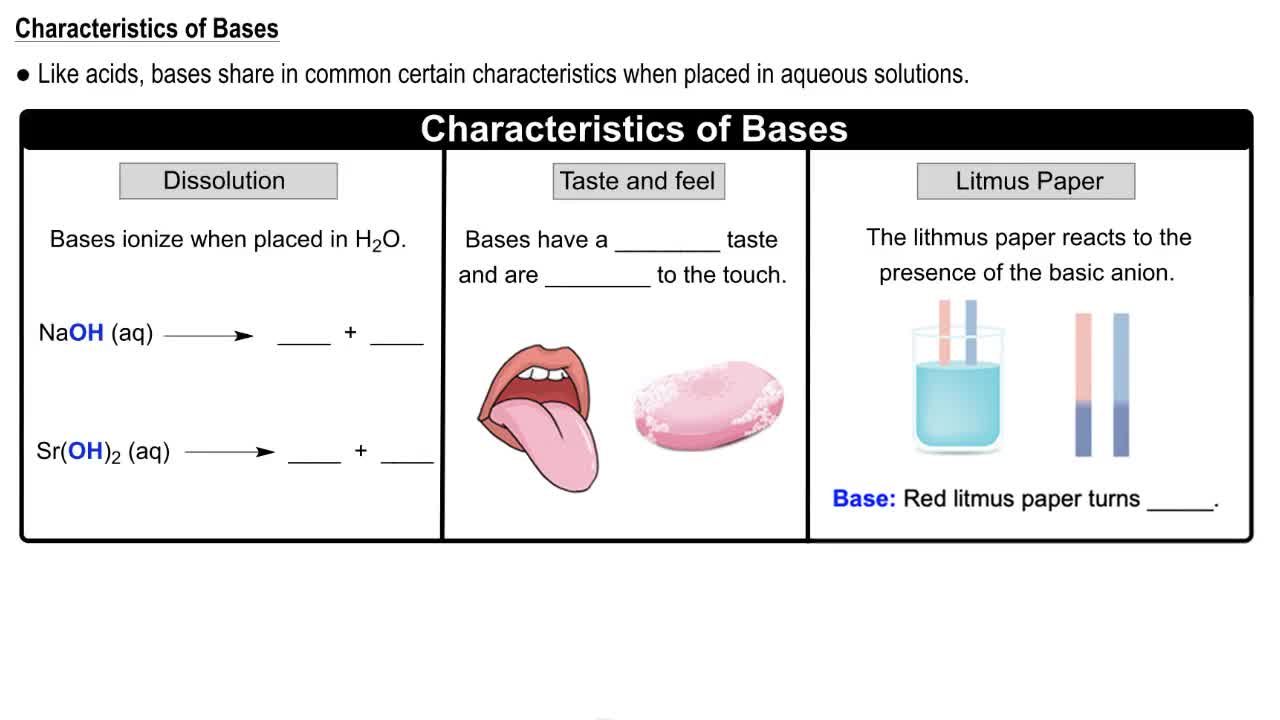
Bases have a bitter taste, a slippery feel, and turn red litmus paper blue.
Bases react with oils on the skin to form soaplike substances, causing a slippery feel.
Sodium hydroxide (NaOH), potassium hydroxide (KOH), and sodium bicarbonate (NaHCO3).
Acidic: blue litmus turns red; red stays red. Basic: red litmus turns blue; blue stays blue. Neutral: both stay their original colors.
An acid produces \(H^+\) ions in aqueous solution.
A base produces \(OH^-\) ions in aqueous solution.
The \(H^+\) from the acid combines with the \(OH^-\) from the base to form water.
Water and a salt, where the salt contains the cation from the base and the anion from the acid.
pH < 7 is acidic, pH = 7 is neutral, and pH > 7 is basic.
pH = −log[\(H_3O^+\)]
Lower pH means higher acidity; higher pH means higher basicity.
Between 7.35 and 7.45, which is slightly basic and tightly regulated for health.
Both concentrations are equal at 1.0 × 10⁻⁷ M.
[\(H_3O^+\)][\(OH^-\)] = 1.0 × 10⁻¹⁴
Acids ionize to produce \(H^+\) and their conjugate base ions. Example: HCl (aq) → \(H^+\) (aq) + Cl− (aq).