 뒤로
뒤로Introduction to Chemistry: Matter, Measurement, and Calculations
 01:34
01:34
이 집합의 용어 (23)
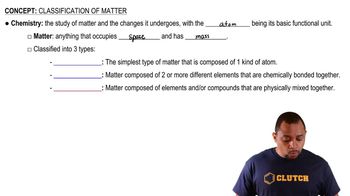
Chemistry is the study of matter and the changes it undergoes, including what substances are made of, their properties, interactions, and chemical reactions.
Matter is anything that has mass and occupies space.
- Solid: definite shape and volume
- Liquid: definite volume, no definite shape
- Gas: no definite shape or volume
- Plasma: high-energy charged particles
Properties that can be observed or measured without changing the substance's identity, such as color, density, melting point, and boiling point.
Properties that describe how a substance can change into another substance, like flammability and reactivity with oxygen.
Physical change: changes form but not identity (e.g., melting ice).
Chemical change: produces new substances (e.g., burning wood).
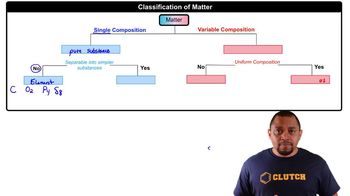
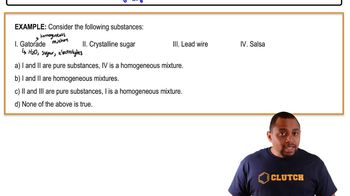
Matter is classified as pure substances (elements and compounds) or mixtures (homogeneous and heterogeneous).
An element is made of only one type of atom and cannot be broken down chemically into simpler substances.
A compound consists of two or more elements chemically bonded, with properties different from its elements (e.g., H\(_2O\)).
Homogeneous: uniform composition (e.g., salt water).
Heterogeneous: not uniform (e.g., salad).
A measurement includes a number and a unit (e.g., 25.0 g).
- Length: meter (m)
- Mass: kilogram (kg)
- Time: second (s)
- Temperature: kelvin (K)
- Amount: mole (mol)
- kilo (k): 1,000
- centi (c): 0.01
- milli (m): 0.001
- micro (μ): 0.000001
- nano (n): 0.000000001
Use the formula \(K=\degree C+273.15\). For example, 25°C = 298.15 K.
Density measures mass per unit volume. Formula: \(D=\frac{m}{V}\).
Density is commonly expressed in g/mL or g/cm³. Note: 1 mL = 1 cm³.
- All nonzero digits are significant.
- Zeros between nonzero digits are significant.
- Leading zeros are not significant.
- Trailing zeros in decimals are significant.
Result should have the same number of significant figures as the measurement with the fewest sig figs.
Result should have the same number of decimal places as the measurement with the fewest decimal places.
Accuracy: closeness to true value.
Precision: closeness of repeated measurements to each other.
A method to convert units by multiplying by conversion factors equal to 1, ensuring unwanted units cancel out.
- Observation
- Question
- Hypothesis
- Experiment
- Data collection and analysis
- Conclusion
- Hypothesis: testable explanation or prediction.
- Theory: well-supported explanation based on evidence.
- Law: description of a consistent natural pattern.