Measured numbers are inexact and have uncertainty (e.g., 5.25 m). Exact numbers have no uncertainty and can be counted exactly (e.g., 24 students).
Uncertainty in Measurements
Every measurement has some degree of uncertainty. The last digit is always uncertain, even with sensitive instruments.
Accuracy vs. Precision
Accuracy is how close a measurement is to the true value. Precision is how close repeated measurements are to each other.
Mass Measurement
Mass is the amount of matter in a substance, measured in grams (g) using a balance. Weight is the force of gravity on an object.
Volume Measurement
Volume is the space occupied by a substance, measured in liters (L) or milliliters (mL). 1 mL = 1 cm\(^3\).
Graduated Cylinder Measurement
Record volume at the meniscus, not the highest point. Uncertainty ranges from +0.1 mL to +0.5 mL.
Scientific Notation
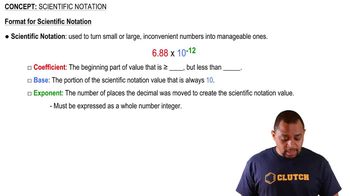
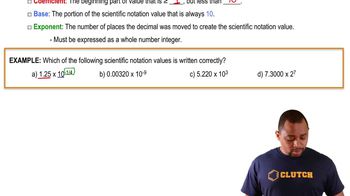
Expresses very large or small numbers as \(N \times 10^n\), where N is between 1 and 9, and n is an integer exponent.
Rules for Significant Figures
All non-zero digits are significant. Zeros between non-zero digits and trailing zeros after a decimal are significant. Leading zeros are not significant.
Rounding with Significant Figures
If the digit to drop is 5 or greater, round up the last significant figure. If less than 5, leave the last significant figure unchanged.
Addition & Subtraction with Sig Figs
Result should have the same number of decimal places as the measurement with the fewest decimal places.
Multiplication & Division with Sig Figs
Result should have the same number of significant figures as the measurement with the fewest significant figures.
Unit Conversion Factor
A ratio of two equivalent quantities used to convert units, e.g., 1 foot = 12 inches.
Exact Equivalents
Two units exactly equal to each other with infinite significant figures, e.g., 1 liter = 1000 milliliters.
Unit Analysis Problem Solving
Carry units through calculations, cancel units properly, and check final units and significant figures.
 뒤로
뒤로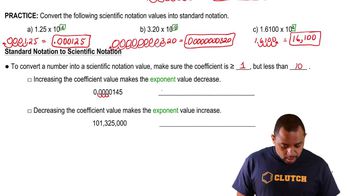
 02:50
02:50