 뒤로
뒤로Introduction to Chemistry - Unit 1 Key Concepts
 01:34
01:34
이 집합의 용어 (20)
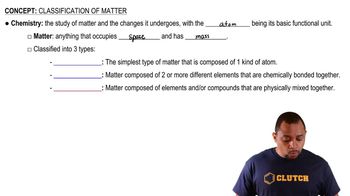
Chemistry is the study of matter, its properties, how and why substances combine or separate, and how substances interact with energy.
Matter is anything that has mass and occupies space.
Energy is the capacity to do work or cause change, and it can be transferred or transformed but not created or destroyed.
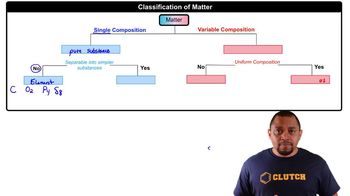
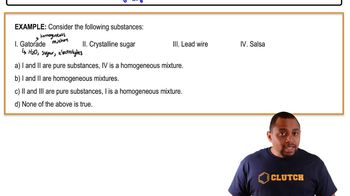
Matter is classified into pure substances (elements and compounds) and mixtures (homogeneous and heterogeneous).
Elements are pure substances made of one type of atom; compounds are pure substances made of two or more elements chemically combined.
Intensive properties do not depend on the amount of matter (e.g., density), while extensive properties depend on the amount (e.g., mass, volume).
Examples include color, melting point, boiling point, density, and state of matter.
Examples include flammability, reactivity with acid, and oxidation states.
Physical changes alter the form but not the identity of a substance; Chemical changes produce new substances with different properties.
Matter is neither created nor destroyed in a chemical reaction; the total mass remains constant.
A given compound always contains the same elements in the same proportion by mass.
The metric system is based on powers of 10, with units like meter (length), gram (mass), and liter (volume).
Precision refers to how close repeated measurements are to each other.
Accuracy refers to how close a measurement is to the true or accepted value.
Rules determine which digits in a measurement are meaningful for precision, including counting all non-zero digits and zeros between them.
Numbers are expressed as \(X.XX \times 10^n\) to simplify very large or small values.
Density is mass divided by volume, \(D=\frac{m}{V}\), usually in g/mL or g/cm3.
Common scales are Celsius, Fahrenheit, and Kelvin; Kelvin is absolute zero scale used in gas laws.
Enthalpy change (ΔH) measures heat absorbed or released during a chemical reaction.
Heat flows from a hotter object to a cooler one until thermal equilibrium is reached.