 뒤로
뒤로States of Matter and Particle Arrangement
 01:35
01:35
이 집합의 용어 (19)
Matter is anything that has mass and takes up space.
The three states of matter are solids, liquids, and gases.
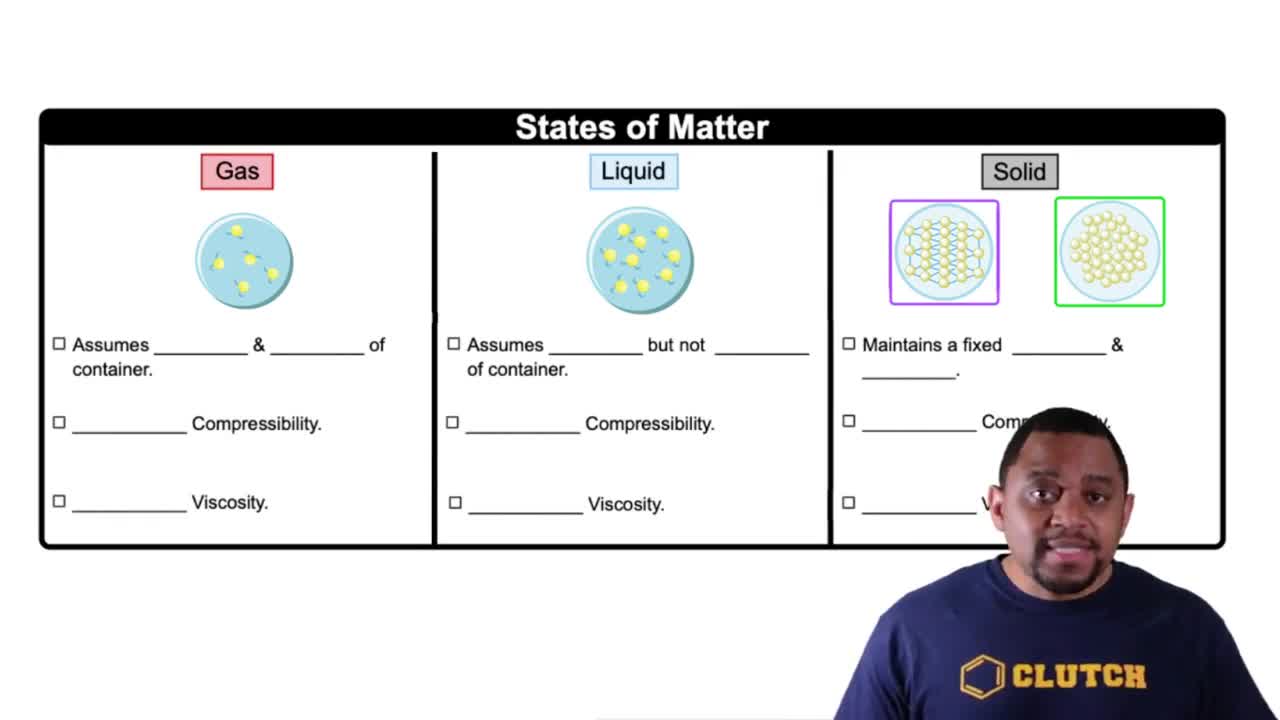
Particles in a solid are tightly packed in a compact structure, allowing only vibration.
Solids have a definite shape and definite volume, with low energy and high density.
When heated, solid particles move faster which causes the solid to expand.
Particles in a liquid are loosely packed, allowing them to move around each other.
Liquids have a definite volume but take the shape of their container. They have medium energy and medium density.
Liquids have enough energy to break free from forces of attraction, allowing particles to move around each other and flow.
Gas particles are very loosely arranged and move quickly in straight lines, colliding with each other and container walls.
Gases have no fixed shape or fixed volume, with high energy and low density.
Particle arrangement determines the movement, density, structure, and energy of solids, liquids, and gases.
Because particles in solids only vibrate in place and cannot move around, solids maintain a fixed shape.
Particles in liquids can move around each other but remain close, so liquids keep volume but take the container's shape.
Gas particles are spread far apart, resulting in low density.
Solids have low energy, liquids have medium energy, and gases have high energy.
Particle movement increases: solids vibrate, liquids flow, and gases move rapidly in straight lines.
Gas particles move freely and quickly, colliding with container walls, allowing gases to fill any container shape and volume.
Forces of attraction keep particles close in solids and liquids but are weak in gases, allowing more freedom of movement.
Heating increases particle energy and movement, causing expansion or changes in state.