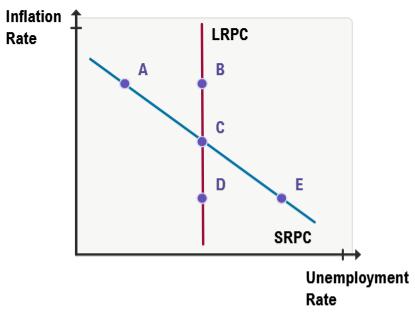
Suppose that an economy has been experiencing actual inflation that is equal to expected inflation. This economy would most likely be operating at point:
A
A
B
B
C
C
D
D
E
E
0 댓글
검증된 단계별 안내
1
Step 1: Understand the Phillips Curve framework. The Short-Run Phillips Curve (SRPC) shows the inverse relationship between inflation and unemployment when inflation expectations are fixed, while the Long-Run Phillips Curve (LRPC) is vertical, representing the natural rate of unemployment where inflation expectations equal actual inflation.
Step 2: Identify the condition where actual inflation equals expected inflation. This condition occurs when the economy is on the Long-Run Phillips Curve (LRPC), because at this point, inflation expectations have adjusted to actual inflation, and there is no surprise inflation.
Step 3: Locate the points on the graph. Points A, C, and E lie on the SRPC, while points B, C, and D lie on the LRPC. Since actual inflation equals expected inflation, the economy must be on the LRPC.
Step 4: Determine the specific point on the LRPC where actual inflation equals expected inflation and the economy is in long-run equilibrium. This is point C, where the SRPC and LRPC intersect, indicating the natural rate of unemployment and stable inflation expectations.
Step 5: Conclude that the economy is most likely operating at point C, as it represents the situation where actual inflation equals expected inflation, consistent with long-run equilibrium on the Phillips Curve.


 검증된 단계별 안내

