Skip to main content
Macroeconomics
나의 코스
배우기
시험 준비
AI 튜터
학습 가이드
플래시카드
탐험해 보세요
앱을 사용해 보세요
나의 코스
배우기
시험 준비
AI 튜터
학습 가이드
플래시카드
탐험해 보세요
앱을 사용해 보세요
뒤로
AE Model: Algebraic Approach quiz
카드를 뒤집기 위해 탭할 수 있습니다.
What is the algebraic equation that defines macroeconomic equilibrium in the AE model?
카드를 뒤집기 위해 탭할 수 있습니다.
👆
What is the algebraic equation that defines macroeconomic equilibrium in the AE model?
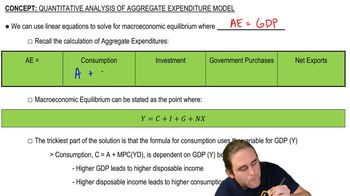
The equilibrium is defined by Y = C + I + G + NX, where Y is GDP and C, I, G, NX are the components of aggregate expenditures.
진행 상황 추적
컨트롤 버튼이 '내비게이션' 모드로 변경되었습니다.
1/15
관련 플래시카드
관련 실천
추천 영상
AE Model: Algebraic Approach definitions
AE Model: Algebraic Approach
13 용어
AE Model: Algebraic Approach
15. Deriving the Aggregate Expenditures Model
10 문제점
주제
Deriving the Multiplier Algebraically
15. Deriving the Aggregate Expenditures Model
10 문제점
주제
16. Deriving the Aggregate Expenditures Model
7 주제
13 문제점
장
VideoThumbView.guidedCourse
04:46
Aggregate Expenditures
1434
views
17
rank
VideoThumbView.guidedCourse
02:20
Algebraic Approach to the AE Model
1486
views
14
rank
이 집합의 용어 (15)
하이드의 정의
What is the algebraic equation that defines macroeconomic equilibrium in the AE model?
The equilibrium is defined by Y = C + I + G + NX, where Y is GDP and C, I, G, NX are the components of aggregate expenditures.
Which components make up aggregate expenditures in the AE model?
Aggregate expenditures are made up of consumption (C), investment (I), government spending (G), and net exports (NX).
How is consumption (C) typically calculated in the algebraic approach to the AE model?
Consumption is calculated as a base amount (a) plus the marginal propensity to consume (MPC) times income (Y): C = a + MPC × Y.
In the AE model, what does the variable Y represent?
Y represents real GDP, which is the total output or income in the economy.
Why is there an interdependence between GDP and consumption in the AE model?
Because as GDP increases, disposable income rises, leading to higher consumption, which in turn can further increase GDP.
What is the marginal propensity to consume (MPC) in the context of the AE model?
MPC is the fraction of additional income that is spent on consumption.
Why do we often not differentiate between income and disposable income in the AE model's algebraic approach?
For simplicity, the model generally treats income and disposable income as the same variable (Y) in calculations.
What is the main goal when using the algebraic approach in the AE model?
The main goal is to solve for the equilibrium level of GDP where aggregate expenditures equal GDP.
How are investment (I), government spending (G), and net exports (NX) typically treated in the AE model equations?
They are usually treated as constant values in the algebraic approach.
What is the 'trickiest part' of solving for equilibrium in the AE model according to the video?
The trickiest part is that consumption depends on GDP, so you must use the GDP value to calculate consumption.
What happens to consumption if GDP increases, according to the AE model?
If GDP increases, consumption also increases because people have more income to spend.
What is the relationship between aggregate expenditures and GDP at equilibrium?
At equilibrium, aggregate expenditures are exactly equal to GDP.
Why do we use linear equations in the algebraic approach to the AE model?
Linear equations allow us to solve for the equilibrium GDP mathematically rather than relying on graphs.
What is the formula for aggregate expenditures in the AE model?
Aggregate expenditures are calculated as AE = C + I + G + NX.
Why is it important to understand the algebraic approach to the AE model?
It helps you solve for macroeconomic equilibrium using equations, which is essential for understanding how changes in components affect GDP.
 뒤로
뒤로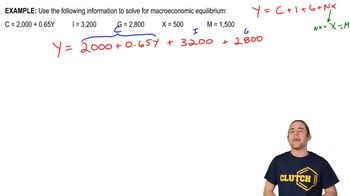
 04:46
04:46