Skip to main content
Macroeconomics
나의 코스
배우기
시험 준비
AI 튜터
학습 가이드
플래시카드
탐험해 보세요
앱을 사용해 보세요
나의 코스
배우기
시험 준비
AI 튜터
학습 가이드
플래시카드
탐험해 보세요
앱을 사용해 보세요
뒤로
Asymmetric Information: Adverse Selection and Moral Hazard definitions
카드를 뒤집기 위해 탭할 수 있습니다.
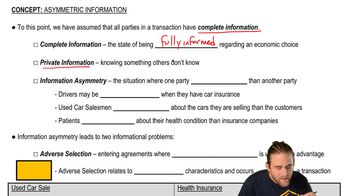
Complete Information
카드를 뒤집기 위해 탭할 수 있습니다.
👆
Complete Information
A scenario where all parties in a transaction possess full knowledge relevant to the exchange, eliminating uncertainty or hidden details.
진행 상황 추적
컨트롤 버튼이 '내비게이션' 모드로 변경되었습니다.
1/13
관련 플래시카드
추천 영상
Asymmetric Information: Adverse Selection and Moral Hazard quiz
Asymmetric Information: Adverse Selection and Moral Hazard
15 용어
VideoThumbView.guidedCourse
04:03
Moral Hazard
4
views
VideoThumbView.guidedCourse
04:42
Adverse Selection
5
views
VideoThumbView.guidedCourse
02:19
Asymmetric Information
4
views
이 집합의 용어 (13)
하이드의 정의
Complete Information
A scenario where all parties in a transaction possess full knowledge relevant to the exchange, eliminating uncertainty or hidden details.
Private Information
Knowledge held by one party but not shared with others, often influencing decisions and outcomes in economic exchanges.
Information Asymmetry
A situation where one participant in a transaction has more or better information than the other, creating an imbalance of power.
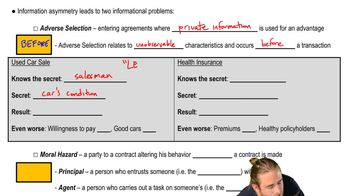
Adverse Selection
A problem arising before agreements, where hidden traits or risks lead to unfavorable outcomes for less-informed parties.
Unobservable Characteristics
Traits or qualities that cannot be easily detected or measured by others, often affecting market decisions.
Lemon Problem
A market issue where buyers fear low-quality goods due to hidden defects, reducing willingness to pay and market efficiency.
Risk Pool
A group of individuals whose collective risks are shared, often becoming riskier when hidden information skews participation.
Premiums
Payments made to maintain insurance coverage, which may rise when insurers face higher-than-expected claims from riskier clients.
Moral Hazard
A challenge occurring after contracts, where one party changes behavior because they no longer bear the full consequences of their actions.
Principal-Agent Relationship
An arrangement where one party delegates tasks to another, often leading to conflicts if interests or information differ.
Monitoring
The process of overseeing another's actions to ensure compliance or effort, often imperfect in employment or insurance settings.
Market Efficiency
The optimal allocation of resources in a market, which can be undermined by hidden information or behavioral changes.
Incentives
Factors that motivate individuals to act in certain ways, shaped by contracts, information, and perceived risks.
 뒤로뒤로
뒤로뒤로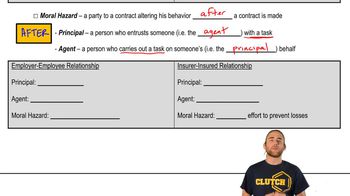
 04:03
04:03