Skip to main content
Macroeconomics
나의 코스
배우기
시험 준비
AI 튜터
학습 가이드
플래시카드
탐험해 보세요
앱을 사용해 보세요
나의 코스
배우기
시험 준비
AI 튜터
학습 가이드
플래시카드
탐험해 보세요
앱을 사용해 보세요
뒤로
Business Cycles and Their Characteristics definitions
카드를 뒤집기 위해 탭할 수 있습니다.
Business Cycle
카드를 뒤집기 위해 탭할 수 있습니다.
👆
Business Cycle
Natural pattern of alternating periods of economic growth and decline, reflected in fluctuations of production, income, and employment.
진행 상황 추적
컨트롤 버튼이 '내비게이션' 모드로 변경되었습니다.
1/14
관련 플래시카드
관련 실천
추천 영상
Business Cycles and Their Characteristics quiz #1
Business Cycles and Their Characteristics
10 용어
Business Cycles and Their Characteristics
12. Productivity and Economic Growth
10 문제점
주제
PPF - Growth Analysis
12. Productivity and Economic Growth
10 문제점
주제
13. Productivity and Economic Growth
6 주제
14 문제점
장
VideoThumbView.guidedCourse
01:46
Business Cycle Characteristics
519
views
13
rank
VideoThumbView.guidedCourse
04:18
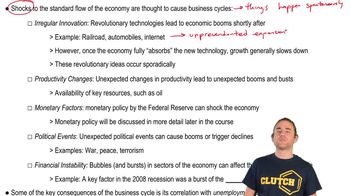
Causes of Business Cycles
1542
views
14
rank
VideoThumbView.guidedCourse
02:33
Key Ideas of the Business Cycle
1427
views
28
rank
이 집합의 용어 (14)
하이드의 정의
Business Cycle
Natural pattern of alternating periods of economic growth and decline, reflected in fluctuations of production, income, and employment.
Expansion
Phase marked by rising production, income, and employment, often driven by increased business activity and consumer spending.
Contraction
Phase characterized by declining production, income, and employment, often resulting in layoffs and reduced economic activity.
Peak
Highest point in economic activity before a downturn, signaling the end of an expansion and the start of a contraction.
Trough
Lowest point in economic activity before recovery begins, marking the transition from contraction to expansion.
Irregular Innovation
Unpredictable technological breakthroughs that trigger sudden economic booms, later absorbed as growth stabilizes.
Productivity Change
Alteration in output efficiency, often due to technology, resource availability, or human capital improvements, impacting economic growth.
Monetary Policy
Actions by the Federal Reserve to influence the economy, such as adjusting interest rates or money supply, causing economic shocks.
Political Event
Unexpected occurrences like wars or terrorism that disrupt economic stability, leading to booms or recessions.
Financial Instability
Market disruptions, such as asset bubbles bursting, that can trigger recessions and widespread economic downturns.
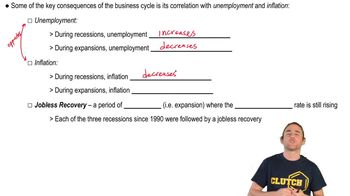
Unemployment
Condition where individuals seeking jobs cannot find work, typically rising during contractions and falling during expansions.
Inflation
General increase in price levels, usually rising during expansions and falling during recessions due to changes in spending.
Jobless Recovery
Situation where economic output grows after a recession, but unemployment remains high or continues to rise.
Economic Shock
Sudden, unexpected event that disrupts normal economic activity, causing rapid changes in growth or recession.
 뒤로뒤로
뒤로뒤로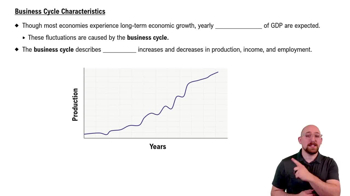
 01:46
01:46