Skip to main content
Macroeconomics
나의 코스
배우기
시험 준비
AI 튜터
학습 가이드
플래시카드
탐험해 보세요
앱을 사용해 보세요
나의 코스
배우기
시험 준비
AI 튜터
학습 가이드
플래시카드
탐험해 보세요
앱을 사용해 보세요
뒤로
Efficiency in Monopolistic Competition definitions
카드를 뒤집기 위해 탭할 수 있습니다.
Productive Efficiency
카드를 뒤집기 위해 탭할 수 있습니다.
👆
Productive Efficiency
Achieved when production occurs at the lowest possible cost, specifically at the minimum point of the average total cost curve.
진행 상황 추적
컨트롤 버튼이 '내비게이션' 모드로 변경되었습니다.
1/15
관련 플래시카드
추천 영상
Efficiency in Monopolistic Competition quiz
Efficiency in Monopolistic Competition
15 용어
VideoThumbView.guidedCourse
03:54
Monopolistic Competition Productive Efficiency
7
views
VideoThumbView.guidedCourse
02:56
Monopolistic Competition Allocative Efficiency
8
views
이 집합의 용어 (15)
하이드의 정의
Productive Efficiency
Achieved when production occurs at the lowest possible cost, specifically at the minimum point of the average total cost curve.
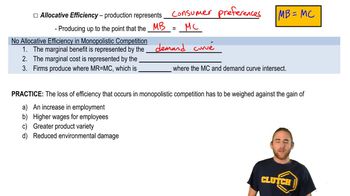
Allocative Efficiency
Occurs when the quantity produced matches consumer preferences, where marginal benefit equals marginal cost.
Average Total Cost
Represents the total cost per unit of output, combining both fixed and variable costs, crucial for efficiency analysis.
Excess Capacity
Describes a situation where firms produce less than the output level that minimizes average total cost, indicating inefficiency.
Marginal Revenue
The additional income from selling one more unit, guiding firms' profit-maximizing output decisions.
Marginal Cost
The extra cost incurred from producing one additional unit, essential for determining optimal production.
Demand Curve
Graphically represents consumers' willingness to pay for different quantities, reflecting marginal benefit.
Profit Maximizing Quantity
The output level where marginal revenue equals marginal cost, chosen by firms to maximize profit.
Zero Profit Point
The situation where price equals average total cost, resulting in no economic profit for firms in the long run.
Economies of Scale
Cost advantages realized as output increases, leading to lower average total costs at higher production levels.
Perfect Competition
A market structure where firms are price takers, achieving both productive and allocative efficiency in the long run.
Imperfect Competition
Market structures, such as monopolistic competition, where firms have some price-setting power and inefficiencies persist.
Socially Optimal Quantity
The output level where consumers' marginal benefit equals producers' marginal cost, maximizing total welfare.
Average Revenue
The revenue earned per unit sold, often equal to price in competitive markets.
Downward Sloping Demand
A characteristic of monopolistic competition, indicating that firms face a negatively sloped demand curve for their product.
 뒤로뒤로
뒤로뒤로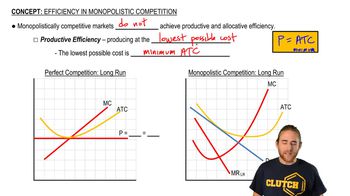
 03:54
03:54