Skip to main content
Macroeconomics
나의 코스
배우기
시험 준비
AI 튜터
학습 가이드
플래시카드
탐험해 보세요
앱을 사용해 보세요
나의 코스
배우기
시험 준비
AI 튜터
학습 가이드
플래시카드
탐험해 보세요
앱을 사용해 보세요
뒤로
Four Market Model Summary: Monopolistic Competition quiz
카드를 뒤집기 위해 탭할 수 있습니다.
How many firms are typically found in monopolistic competition?
카드를 뒤집기 위해 탭할 수 있습니다.
👆
How many firms are typically found in monopolistic competition?
There are many firms in monopolistic competition, though not as many as in perfect competition.
진행 상황 추적
컨트롤 버튼이 '내비게이션' 모드로 변경되었습니다.
1/15
관련 플래시카드
추천 영상
Four Market Model Summary: Monopolistic Competition definitions
Four Market Model Summary: Monopolistic Competition
15 용어
VideoThumbView.guidedCourse
03:30
Four Market Model Summary: Monopolistic Competition
5
views
이 집합의 용어 (15)
하이드의 정의
How many firms are typically found in monopolistic competition?
There are many firms in monopolistic competition, though not as many as in perfect competition.
What are two common examples of monopolistically competitive markets?
Fast food and coffee markets are common examples of monopolistically competitive markets.
What is meant by 'barriers to entry' in a market?
Barriers to entry are obstacles that prevent new firms from entering a market.
How do barriers to entry in monopolistic competition compare to perfect competition?
Both have low or no barriers to entry, making it easy for new firms to enter the market.
At what point do firms in monopolistic competition maximize profit?
Firms maximize profit where marginal revenue equals marginal cost (MR = MC).
In the long run, what happens to economic profit in monopolistic competition?
Economic profit becomes zero in the long run because price equals average total cost (P = ATC).
How is price determined for a firm in monopolistic competition?
Price is determined from the demand curve at the profit-maximizing quantity.
What is the relationship between price and marginal revenue in monopolistic competition?
Price is greater than marginal revenue due to the downward-sloping demand curve.
What is the relationship between price and marginal cost in monopolistic competition?
Price is greater than marginal cost, creating a markup over marginal cost.
Why does monopolistic competition have a downward-sloping demand curve?
Because firms have some control over price and can differentiate their products.
What is the equilibrium condition for monopolistic competition in the long run?
The equilibrium condition is where price equals average total cost (P = ATC).
How does monopolistic competition differ from perfect competition in terms of price-setting?
Firms in monopolistic competition are price-setters, while those in perfect competition are price-takers.
What does the markup in monopolistic competition represent?
The markup represents the difference between price and marginal cost.
How can you calculate profit for a firm in monopolistic competition using a graph?
Profit is calculated by finding the difference between price and average total cost at the profit-maximizing quantity.
Why is understanding monopolistic competition important for analyzing market structures?
It highlights differences in price-setting, market entry, and equilibrium conditions compared to other market structures.
 뒤로뒤로
뒤로뒤로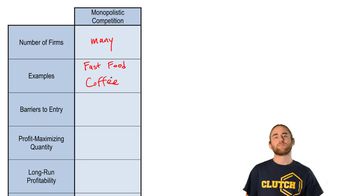
 03:30
03:30