Macroeconomics
나의 코스
배우기
시험 준비
AI 튜터
학습 가이드
플래시카드
탐험해 보세요
앱을 사용해 보세요
나의 코스
배우기
시험 준비
AI 튜터
학습 가이드
플래시카드
탐험해 보세요
앱을 사용해 보세요
뒤로
Introduction to Economics definitions
카드를 뒤집기 위해 탭할 수 있습니다.
Scarcity
카드를 뒤집기 위해 탭할 수 있습니다.
👆
Scarcity
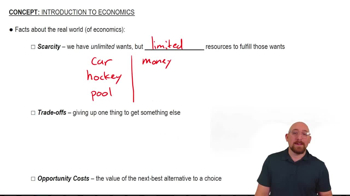
A situation where resources are insufficient to satisfy all human wants, requiring choices about their allocation.
진행 상황 추적
컨트롤 버튼이 '내비게이션' 모드로 변경되었습니다.
1/15
관련 플래시카드
관련 실천
추천 영상
Introduction to Economics quiz #1
Introduction to Economics
38 용어
Introduction to Economics quiz #2
Introduction to Economics
33 용어
Introduction to Economics
1. Introduction to Macroeconomics
10 문제점
주제
Three Key Economic Ideas
1. Introduction to Macroeconomics
10 문제점
주제
1. Introduction to Macroeconomics
8 주제
14 문제점
장
04:30
Defining Economic Terms: Scarcity, Trade-offs, and Opportunity Costs
24384
views
906
rank
6
comments
VideoThumbView.guidedCourse
02:04
Definition of Economics: Micro vs. Macro
9427
views
380
rank
01:42
Economic Systems
1893
views
95
rank
이 집합의 용어 (15)
하이드의 정의
Scarcity
A situation where resources are insufficient to satisfy all human wants, requiring choices about their allocation.
Trade-off
A situation where obtaining one thing necessitates giving up another, reflecting the need to prioritize among alternatives.
Opportunity Cost
The value of the next best alternative forgone when a choice is made, not just monetary but also time or experiences.
Resource
An input such as time, money, or materials that is limited and used to fulfill various wants or needs.
Economics
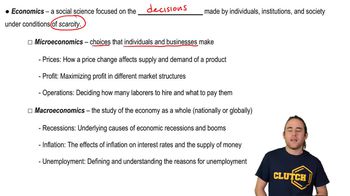
A social science focused on how individuals, institutions, and societies make decisions under conditions of limited means.
Microeconomics
A branch examining choices and behaviors of individuals and businesses, including pricing, supply, and demand in specific markets.
Macroeconomics
A field studying the economy as a whole, including national issues like inflation, unemployment, and economic growth.
Economic System
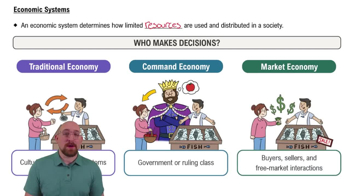
A structure determining how a society allocates and distributes its limited resources, shaped by decision-makers.
Traditional Economy
A system where customs, traditions, and long-standing practices guide resource allocation and production.
Command Economy
A structure where a government or ruling authority directs production, distribution, and pricing decisions.
Market Economy
A system where buyers and sellers interact freely, with voluntary exchanges and competition shaping outcomes.
Voluntary Exchange
A process where individuals freely decide what to buy or sell, reflecting personal preferences and mutual benefit.
Competition
A dynamic where producers strive to attract buyers by offering better prices or features, influencing market outcomes.
Inflation
A general rise in price levels across an economy, affecting purchasing power and interest rates.
Unemployment
A condition where individuals willing and able to work cannot find jobs, impacting overall economic health.