Skip to main content
Macroeconomics
나의 코스
배우기
시험 준비
AI 튜터
학습 가이드
플래시카드
탐험해 보세요
앱을 사용해 보세요
나의 코스
배우기
시험 준비
AI 튜터
학습 가이드
플래시카드
탐험해 보세요
앱을 사용해 보세요
뒤로
Isoquant Lines definitions
카드를 뒤집기 위해 탭할 수 있습니다.
Isoquant Line
카드를 뒤집기 위해 탭할 수 있습니다.
👆
Isoquant Line
A curve showing all possible combinations of two inputs that yield the same level of output, such as a fixed number of cookies.
진행 상황 추적
컨트롤 버튼이 '내비게이션' 모드로 변경되었습니다.
1/15
관련 플래시카드
추천 영상
Isoquant Lines quiz
Isoquant Lines
15 용어
VideoThumbView.guidedCourse
09:45
Isoquant Lines
6
views
이 집합의 용어 (15)
하이드의 정의
Isoquant Line
A curve showing all possible combinations of two inputs that yield the same level of output, such as a fixed number of cookies.
Labor
The human effort, such as bakers, used in the production process to create goods like cookies.
Capital
Physical assets, such as ovens or machinery, used alongside labor to produce goods.
Bundle
A specific combination of input quantities, like a certain number of ovens and bakers, used to achieve a set output.
Marginal Rate of Technical Substitution
The rate at which one input can replace another while keeping output constant, calculated as the slope of the isoquant.
Slope
A measure representing the rate of input substitution along an isoquant, found by dividing the change in one input by the change in another.
Diminishing Marginal Productivity
A phenomenon where adding more of one input yields progressively smaller increases in output, making substitution less efficient.
Production Level
A fixed quantity of output, such as 500 or 750 cookies, achieved by various input combinations.
Resource Allocation
The process of distributing inputs like labor and capital to optimize production efficiency and cost.
Cost Efficiency
Achieving a desired output at the lowest possible input cost by selecting the optimal input combination.
Indifference Curve
A concept from consumer theory, similar in shape to isoquants, representing combinations yielding equal satisfaction.
Input Substitution
The process of replacing one input with another, such as using more labor instead of capital, to maintain output.
Output
The total quantity of goods produced, such as the number of cookies, resulting from specific input combinations.
Average Labor Productivity
The amount of output produced per unit of labor input, reflecting efficiency in the use of workers.
Factors of Production
The essential resources, including labor and capital, combined in various ways to generate goods and services.
 뒤로뒤로
뒤로뒤로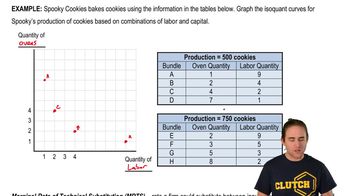
 09:45
09:45