Skip to main content
Macroeconomics
나의 코스
배우기
시험 준비
AI 튜터
학습 가이드
플래시카드
탐험해 보세요
앱을 사용해 보세요
나의 코스
배우기
시험 준비
AI 튜터
학습 가이드
플래시카드
탐험해 보세요
앱을 사용해 보세요
뒤로
Market for Loanable Funds quiz
카드를 뒤집기 위해 탭할 수 있습니다.
What is the market for loanable funds?
카드를 뒤집기 위해 탭할 수 있습니다.
👆
What is the market for loanable funds?
It is the market where household savings are made available for borrowing by investors and firms for investment purposes.
진행 상황 추적
컨트롤 버튼이 '내비게이션' 모드로 변경되었습니다.
1/15
관련 플래시카드
관련 실천
추천 영상
Market for Loanable Funds definitions
Market for Loanable Funds
15 용어
Market for Loanable Funds
13. The Financial System
10 문제점
주제
Shifts in the Market for Loanable Funds
13. The Financial System
10 문제점
주제
14. The Financial System - Part 1 of 2
8 주제
15 문제점
장
13. The Financial System - Part 2 of 2
1 주제
3 문제점
장
VideoThumbView.guidedCourse
04:42
Market for Loanable Funds
293
views
9
rank
이 집합의 용어 (15)
하이드의 정의
What is the market for loanable funds?
It is the market where household savings are made available for borrowing by investors and firms for investment purposes.
Where does the supply of loanable funds come from?
The supply comes from household savings, which are funds left over after households spend their income.
Who primarily demands loanable funds in the market?
Firms are the primary demanders, borrowing to invest in business expansions, though households also borrow for large purchases.
What does the interest rate represent in the market for loanable funds?
The interest rate is the price of borrowing funds, expressed as a percentage of the amount borrowed.
How does a high interest rate affect the supply and demand for loanable funds?
A high interest rate increases the supply (more savings) but decreases the demand (less borrowing) for loanable funds.
What happens to the quantity demanded of loanable funds when interest rates are low?
The quantity demanded increases because borrowing becomes cheaper.
How is equilibrium determined in the market for loanable funds?
Equilibrium is where the supply and demand curves for loanable funds intersect, setting the equilibrium interest rate and quantity.
What labels are used for the axes in the loanable funds market graph?
The x-axis is quantity of loanable funds, and the y-axis is the interest rate.
Why do households supply more loanable funds at higher interest rates?
Because higher interest rates make saving more attractive, offering greater returns on their savings.
Why do firms demand more loanable funds at lower interest rates?
Lower interest rates reduce the cost of borrowing, making more investments profitable for firms.
What is the role of banks in the market for loanable funds?
Banks act as intermediaries, taking household savings and lending them out to investors and firms.
What is meant by the equilibrium interest rate (R*)?
It is the interest rate at which the quantity of loanable funds supplied equals the quantity demanded.
How do shifts in the supply or demand curves affect the equilibrium in the loanable funds market?
Shifts can change the equilibrium interest rate and the quantity of loanable funds exchanged.
What determines whether a firm will borrow funds for investment?
A firm will borrow if the expected return on investment exceeds the interest rate on the loan.
Why is the real interest rate important in the loanable funds market?
The real interest rate, adjusted for inflation, reflects the true cost of borrowing and the real return to savers.
 뒤로뒤로
뒤로뒤로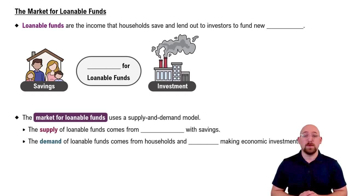
 04:42
04:42