Skip to main content
Macroeconomics
나의 코스
배우기
시험 준비
AI 튜터
학습 가이드
플래시카드
탐험해 보세요
앱을 사용해 보세요
나의 코스
배우기
시험 준비
AI 튜터
학습 가이드
플래시카드
탐험해 보세요
앱을 사용해 보세요
뒤로
New Classical Model quiz
카드를 뒤집기 위해 탭할 수 있습니다.
Who developed the new classical model of economics in the 1970s?
카드를 뒤집기 위해 탭할 수 있습니다.
👆
Who developed the new classical model of economics in the 1970s?
Robert Lucas, Thomas Sargent, and Robert Barrow developed the new classical model.
진행 상황 추적
컨트롤 버튼이 '내비게이션' 모드로 변경되었습니다.
1/15
관련 플래시카드
관련 실천
추천 영상
New Classical Model definitions
New Classical Model
15 용어
New Classical Model
22. Macroeconomic Schools of Thought
9 문제점
주제
Real Business Cycle Model
22. Macroeconomic Schools of Thought
10 문제점
주제
24. Macroeconomic Schools of Thought
7 주제
15 문제점
장
VideoThumbView.guidedCourse
04:33
New Classical Model
1268
views
7
rank
이 집합의 용어 (15)
하이드의 정의
Who developed the new classical model of economics in the 1970s?
Robert Lucas, Thomas Sargent, and Robert Barrow developed the new classical model.
What does the new classical model assume about the economy's position relative to potential GDP?
It assumes the economy tends to operate at potential GDP, meaning full employment and full use of resources.
How does the new classical model view the flexibility of wages and prices?
It views wages and prices as flexible, able to adjust quickly to changes in supply and demand.
What is the main difference between the Keynesian and new classical models regarding price and wage adjustment?
The Keynesian model sees prices and wages as sticky, while the new classical model sees them as flexible.
What is the concept of rational expectations in the new classical model?
Rational expectations means firms and workers make decisions based on their expectations of future economic variables, especially inflation.
How do discrepancies between expected and actual inflation affect the economy in the new classical model?
They can lead to shifts in the short run Phillips curve, impacting both inflation and unemployment rates.
What policy does the new classical model support to help form accurate inflation expectations?
It supports a monetary growth rule, advocating for steady increases in the money supply.
Why does the new classical model advocate for a steady growth rule in the money supply?
A steady growth rule helps firms and workers make better predictions about future inflation.
How does the new classical model's view of full employment compare to the classical model?
Both models believe the economy tends to be at full employment and potential GDP.
What happens if actual inflation is higher than expected inflation according to the new classical model?
It causes economic repercussions, such as shifts in the short run Phillips curve.
How does the new classical model differ from the monetarist model?
While both support a steady money supply, the new classical model emphasizes rational expectations and flexible prices and wages.
What is the main focus of introductory macroeconomics courses according to the transcript?
The main focus is on the Keynesian model, with the new classical model providing a contrasting perspective.
How do unions and contracts affect wage flexibility in the Keynesian model?
Unions and contracts make wages sticky, preventing quick adjustments to economic changes.
What is the effect of a steady monetary growth rule on inflation expectations?
It allows firms and workers to form more accurate expectations about future inflation.
Why is understanding the new classical model important even if the course focuses on Keynesian economics?
It provides a contrasting perspective on economic dynamics and helps understand different policy implications.
 뒤로뒤로
뒤로뒤로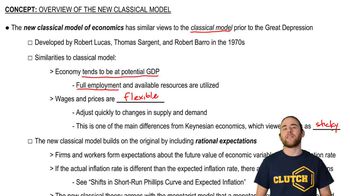
 04:33
04:33