Macroeconomics
나의 코스
배우기
시험 준비
AI 튜터
학습 가이드
플래시카드
탐험해 보세요
앱을 사용해 보세요
나의 코스
배우기
시험 준비
AI 튜터
학습 가이드
플래시카드
탐험해 보세요
앱을 사용해 보세요
뒤로
Productive and Allocative Efficiency definitions
카드를 뒤집기 위해 탭할 수 있습니다.
Efficiency
카드를 뒤집기 위해 탭할 수 있습니다.
👆
Efficiency
Maximizing benefits from scarce resources, ensuring society gets the most output possible from what is available.
진행 상황 추적
컨트롤 버튼이 '내비게이션' 모드로 변경되었습니다.
1/14
관련 플래시카드
관련 실천
추천 영상
Productive and Allocative Efficiency quiz
Productive and Allocative Efficiency
15 용어
Productive and Allocative Efficiency
1. Introduction to Macroeconomics
10 문제점
주제
Factors of Production
1. Introduction to Macroeconomics
10 문제점
주제
1. Introduction to Macroeconomics
8 주제
14 문제점
장
04:14
Equity and Fairness
5262
views
195
rank
03:26
Productive Efficiency and Allocative Efficiency
8459
views
220
rank
1
comments
이 집합의 용어 (14)
하이드의 정의
Efficiency
Maximizing benefits from scarce resources, ensuring society gets the most output possible from what is available.
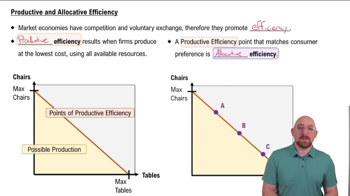
Productive Efficiency
Achieved when output is maximized at the lowest cost, with all resources fully utilized along the production possibility frontier.
Allocative Efficiency
Occurs when the mix of goods produced matches consumer preferences, reflecting what society values most.
Production Possibility Frontier
A curve showing all possible combinations of two goods that can be produced with available resources and technology.
Inefficiency
A situation where more output could be produced with the same resources, indicating underutilization.
Attainable Point
Any combination of goods that can be produced with current resources, represented inside or on the production possibility frontier.
Unattainable Point
A combination of goods that cannot be produced with current resources, lying outside the production possibility frontier.
Scarce Resources
Inputs that are limited in supply, requiring choices about their best use to maximize benefits.
Equality
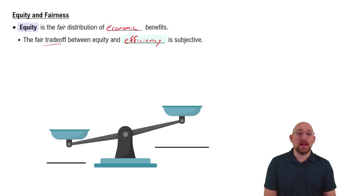
The fair distribution of economic benefits, often involving ethical considerations about who receives what.
Distribution
The way economic benefits or goods are shared among members of society, influencing fairness and equity.
Output
The total amount of goods or services produced by an economy using its available resources.
Cost
The value of resources used to produce goods, which productive efficiency seeks to minimize.
Consumer Preferences
The desires and priorities of buyers, guiding which goods should be produced for allocative efficiency.
Ethics
Moral principles influencing decisions about fairness and the appropriateness of economic outcomes.