Skip to main content
Macroeconomics
나의 코스
배우기
시험 준비
AI 튜터
학습 가이드
플래시카드
탐험해 보세요
앱을 사용해 보세요
나의 코스
배우기
시험 준비
AI 튜터
학습 가이드
플래시카드
탐험해 보세요
앱을 사용해 보세요
뒤로
Short Run Shutdown Decision definitions
카드를 뒤집기 위해 탭할 수 있습니다.
Perfect Competition
카드를 뒤집기 위해 탭할 수 있습니다.
👆
Perfect Competition
A market structure where firms are price takers due to identical products and many sellers, leading to horizontal demand curves.
진행 상황 추적
컨트롤 버튼이 '내비게이션' 모드로 변경되었습니다.
1/14
관련 플래시카드
추천 영상
Short Run Shutdown Decision quiz
Short Run Shutdown Decision
15 용어
VideoThumbView.guidedCourse
03:28
Short Run Shutdown Decision
5
views
VideoThumbView.guidedCourse
07:54
Short Run Shutdown Decision (continued)
4
views
VideoThumbView.guidedCourse
07:05
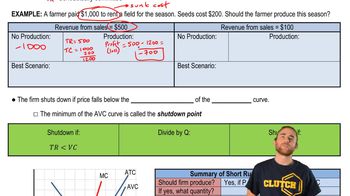
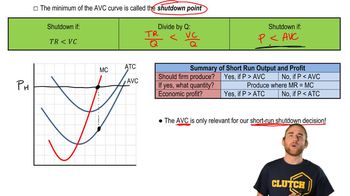
Short Run Shutdown Decision on the Graph
5
views
이 집합의 용어 (14)
하이드의 정의
Perfect Competition
A market structure where firms are price takers due to identical products and many sellers, leading to horizontal demand curves.
Short Run
A period in which at least one input, typically fixed costs, cannot be changed, affecting production decisions.
Fixed Cost
An expense that remains unchanged regardless of output, such as rent, and must be paid even if production stops.
Variable Cost
An expense that changes with the level of output, like seeds for a farmer, and is avoidable if production ceases.
Sunk Cost
An unrecoverable expense, such as prepaid rent, that cannot be refunded or avoided, regardless of future actions.
Shutdown Point
The output level where market price equals the minimum average variable cost, below which production halts temporarily.
Average Variable Cost
The per-unit variable expense, crucial for determining whether a firm should continue producing in the short run.
Average Total Cost
The per-unit sum of all expenses, both fixed and variable, used to assess profitability at a given output.
Marginal Cost
The additional expense incurred from producing one more unit, guiding the optimal output decision.
Marginal Revenue
The extra income from selling one more unit, equal to price in perfect competition, and key for output decisions.
Profit Maximizing Quantity
The output level where marginal revenue equals marginal cost, ensuring the highest possible profit or smallest loss.
Loss Minimization
A strategy where a firm continues production if losses are less than fixed costs, even when not profitable.
Exit
A permanent decision to leave a market, resulting in zero output and avoidance of all future costs.
Aggregate Supply
The total quantity of goods firms are willing to produce at various price levels, influenced by short-run constraints.
 뒤로뒤로
뒤로뒤로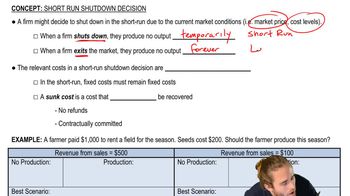
 03:28
03:28