Skip to main content
Macroeconomics
나의 코스
배우기
시험 준비
AI 튜터
학습 가이드
플래시카드
탐험해 보세요
앱을 사용해 보세요
나의 코스
배우기
시험 준비
AI 튜터
학습 가이드
플래시카드
탐험해 보세요
앱을 사용해 보세요
뒤로
The Bretton Woods System definitions
카드를 뒤집기 위해 탭할 수 있습니다.
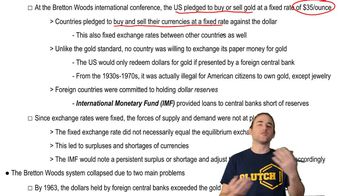
Bretton Woods System
카드를 뒤집기 위해 탭할 수 있습니다.
👆
Bretton Woods System
A postwar arrangement where currencies were pegged to the US dollar, which was convertible to gold at a fixed rate.
진행 상황 추적
컨트롤 버튼이 '내비게이션' 모드로 변경되었습니다.
1/15
관련 플래시카드
관련 실천
추천 영상
The Bretton Woods System quiz
The Bretton Woods System
15 용어
22. Balance of Payments
5 주제
15 문제점
장
VideoThumbView.guidedCourse
02:53
Bretton Woods System: Collapse
107
views
VideoThumbView.guidedCourse
04:04
Bretton Woods System: Introduction
127
views
1
rank
이 집합의 용어 (15)
하이드의 정의
Bretton Woods System
A postwar arrangement where currencies were pegged to the US dollar, which was convertible to gold at a fixed rate.
Fixed Exchange Rate
A regime where a currency's value is tied to another currency or commodity, preventing market forces from setting rates.
Gold Standard
A monetary system where currency value is directly linked to a specific amount of gold.
US Dollar
The central reserve currency under the postwar system, serving as the anchor for global exchange rates.
Gold Reserves
Holdings of the precious metal by central banks, used to back the value of issued currency.
Dollar Reserves
Foreign central banks' holdings of US currency, used to maintain exchange rate stability.
International Monetary Fund
An institution created to provide financial assistance to countries facing reserve shortages.
Central Bank
A national authority responsible for managing currency, reserves, and monetary policy.
Currency Revaluation
An official increase in a currency's value relative to others, often resisted to protect export competitiveness.
Currency Undervaluation
A situation where a currency's fixed rate is set below its market equilibrium, boosting exports but causing imbalances.
Surplus
An excess supply of a currency at a fixed rate, often requiring intervention or adjustment.
Shortage
A lack of sufficient currency supply at a fixed rate, leading to pressure for revaluation or external support.
Managed Float System
A post-1973 regime where exchange rates are mostly market-determined, with occasional government intervention.
Inflation
A general rise in prices, often resulting from excessive money creation or persistent currency imbalances.
Export Competitiveness
The advantage gained by keeping a currency undervalued, making goods cheaper for foreign buyers.
 뒤로뒤로
뒤로뒤로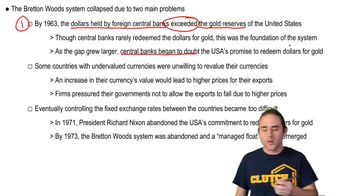
 02:53
02:53