Skip to main content
Macroeconomics
나의 코스
배우기
시험 준비
AI 튜터
학습 가이드
플래시카드
탐험해 보세요
앱을 사용해 보세요
나의 코스
배우기
시험 준비
AI 튜터
학습 가이드
플래시카드
탐험해 보세요
앱을 사용해 보세요
뒤로
Three Key Economic Ideas definitions
카드를 뒤집기 위해 탭할 수 있습니다.
Rationality
카드를 뒤집기 위해 탭할 수 있습니다.
👆
Rationality
Assumes individuals and firms aim to do their best with available resources, avoiding self-destructive choices.
진행 상황 추적
컨트롤 버튼이 '내비게이션' 모드로 변경되었습니다.
1/15
관련 플래시카드
관련 실천
추천 영상
Three Key Economic Ideas quiz #1
Three Key Economic Ideas
10 용어
Three Key Economic Ideas
1. Introduction to Macroeconomics
10 문제점
주제
Productive and Allocative Efficiency
1. Introduction to Macroeconomics
10 문제점
주제
1. Introduction to Macroeconomics - Part 1 of 2
8 주제
14 문제점
장
1. Introduction to Macroeconomics - Part 2 of 2
1 주제
3 문제점
장
VideoThumbView.guidedCourse
09:36
Marginal Analysis
10896
views
328
rank
VideoThumbView.guidedCourse
02:02
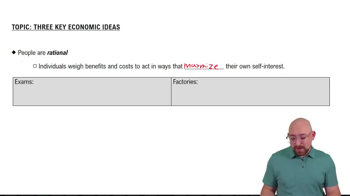
People Are Rational
13500
views
351
rank
VideoThumbView.guidedCourse
01:40
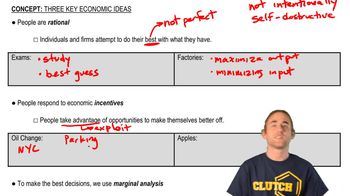
Economic Incentives
11146
views
365
rank
이 집합의 용어 (15)
하이드의 정의
Rationality
Assumes individuals and firms aim to do their best with available resources, avoiding self-destructive choices.
Economic Incentives
Opportunities or rewards that motivate people to adjust their behavior for personal benefit.
Marginal Analysis
Decision-making process focused on evaluating the impact of one additional unit of an activity.
Marginal Benefit
Additional satisfaction or happiness gained from consuming one more unit of a good or service.
Marginal Cost
Extra cost, not limited to money, incurred from producing or consuming one more unit of something.
Optimum Consumption
Point where the extra satisfaction from consumption equals the extra cost, maximizing personal benefit.
Allocative Efficiency
Situation where resources are distributed so that marginal benefit equals marginal cost across society.
Subjectivity
Variation in preferences and satisfaction levels, leading to different optimal choices for each individual.
Graph
Visual tool using lines and colors to illustrate relationships between economic variables, aiding understanding.
Opportunity
Alternative or option that can be exploited to improve one’s situation, often in response to incentives.
Satisfaction
Level of happiness or utility derived from consuming goods or services, often measured incrementally.
Input
Resources such as time, money, or effort used in the production or consumption process.
Output
Resulting goods or services produced from utilizing inputs in a decision-making process.
Waste
Unused or inefficiently used resources that do not contribute to desired outcomes.
Profit Maximization
Goal of achieving the highest possible difference between total revenue and total cost in business decisions.
 뒤로뒤로
뒤로뒤로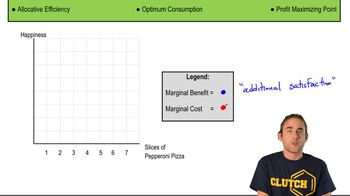
 09:36
09:36