Skip to main content
Macroeconomics
나의 코스
배우기
시험 준비
AI 튜터
학습 가이드
플래시카드
탐험해 보세요
앱을 사용해 보세요
나의 코스
배우기
시험 준비
AI 튜터
학습 가이드
플래시카드
탐험해 보세요
앱을 사용해 보세요
뒤로
Value Added Method for Measuring GDP quiz
카드를 뒤집기 위해 탭할 수 있습니다.
What is the value added approach to calculating GDP?
카드를 뒤집기 위해 탭할 수 있습니다.
👆
What is the value added approach to calculating GDP?
It is the sum of value added by firms producing final goods and services.
진행 상황 추적
컨트롤 버튼이 '내비게이션' 모드로 변경되었습니다.
1/15
관련 플래시카드
관련 실천
추천 영상
Value Added Method for Measuring GDP definitions
Value Added Method for Measuring GDP
14 용어
Value Added Method for Measuring GDP
10. Measuring National Output and Income
10 문제점
주제
Shortcomings of GDP
10. Measuring National Output and Income
10 문제점
주제
11. Gross Domestic Product (GDP) and Consumer Price Index (CPI)
7 주제
10 문제점
장
VideoThumbView.guidedCourse
02:21
GDP and the Value-Added Approach
545
views
22
rank
이 집합의 용어 (15)
하이드의 정의
What is the value added approach to calculating GDP?
It is the sum of value added by firms producing final goods and services.
How do you calculate value added for a firm?
Value added is the sale price of the good minus the cost of any intermediate goods used to produce it.
In the value added method, what are intermediate goods?
Intermediate goods are goods that are used as inputs in the production of final goods.
What is the value added by the farm in the wheat-flour-bread example?
The farm adds \$2 of value, calculated as \$2 sale price minus \$0 cost of intermediate goods.
How much value does the flour mill add in the example?
The flour mill adds \$3 of value, calculated as \$5 sale price minus \$2 cost of wheat.
What is the value added by the bakery in the example?
The bakery adds \$2.50 of value, calculated as \$7.50 sale price minus \$5 cost of flour.
What is the total value added in the wheat-flour-bread example?
The total value added is \$7.50, which is the sum of value added by the farm, flour mill, and bakery.
How does the value added approach relate to the expenditure approach?
Both approaches yield the same GDP value, as the total value added equals the value of final expenditures.
Why does the value of the final good equal the total value added?
Because each stage adds value, and the sum of all stages equals the final sale price of the good.
What is the main takeaway from using the value added approach?
It shows how much value each firm contributes and that all GDP calculation methods give the same result.
Why is it important to subtract the cost of intermediate goods when calculating value added?
To avoid double counting, since intermediate goods are already included in the final good's price.
Which countries commonly use the value added approach for GDP?
A few countries in Europe and Asia use this approach.
What does the value added approach emphasize in national income accounting?
It emphasizes the role of intermediate and final goods in aggregating economic activity.
Do the value added, expenditure, and income approaches to GDP give different results?
No, all three approaches yield the same GDP value.
What does the value added method help us understand about production stages?
It helps us see how value is created and added at each stage of production.
 뒤로뒤로
뒤로뒤로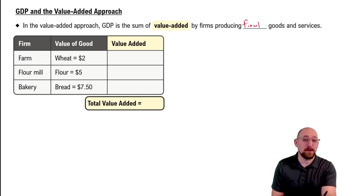
 02:21
02:21