 뒤로
뒤로Macroeconomics: Inflation
 08:35
08:35
이 집합의 용어 (20)
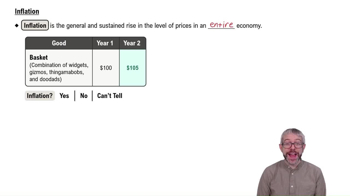
Inflation is the general increase in prices of goods and services over time, reducing the purchasing power of money.
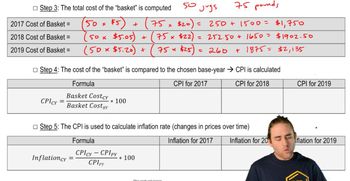
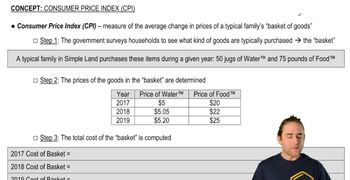
Inflation is commonly measured by the Consumer Price Index (CPI) or the Producer Price Index (PPI), which track price changes of a basket of goods and services.
Demand-pull inflation occurs when aggregate demand exceeds aggregate supply, pushing prices up.
Cost-push inflation happens when rising production costs, like wages or raw materials, increase overall prices.
Hyperinflation is an extremely high and typically accelerating inflation rate, often exceeding 50% per month.
Inflation decreases purchasing power because each unit of currency buys fewer goods and services over time.
The inflation rate is calculated as \(\frac{P_t - P_{t-1}}{P_{t-1}} \times 100\), where P is the price level at time t.
Nominal values are measured in current prices, while real values are adjusted for inflation to reflect true purchasing power.
The Phillips Curve shows an inverse relationship between inflation and unemployment in the short run.
Higher inflation often leads to higher nominal interest rates as lenders demand compensation for reduced purchasing power.
Anticipated inflation is expected and can be planned for, while unanticipated inflation causes unexpected losses or gains.
Central banks use monetary policy tools like interest rates to control inflation and maintain price stability.
Deflation is a decrease in the general price level, increasing the purchasing power of money.
Costs include menu costs, shoe leather costs, uncertainty, and distorted price signals.
Headline inflation includes all items, while core inflation excludes volatile food and energy prices.
Inflation erodes the real value of savings unless interest rates exceed the inflation rate.
The theory states that MV = PY, linking money supply (M), velocity (V), price level (P), and output (Y).
Stagflation is a situation with high inflation and high unemployment simultaneously.
Inflation can redistribute income by hurting fixed-income earners and benefiting debtors.
The Fisher effect describes how nominal interest rates adjust to expected inflation to keep real rates stable.