Use the following choices to answer the question. a. E. coli growing in glucose broth at 35℃ with O2 for 5 days b. E. coli growing in glucose broth at 35℃ without O2 for 5 days c. Both a and b d. Neither a nor b
Which culture produces the most lactic acid?
검증된 단계별 안내
1
Step 1: Understand the metabolic pathways of E. coli under aerobic and anaerobic conditions. E. coli can perform aerobic respiration when oxygen is present and switch to fermentation or anaerobic respiration when oxygen is absent.
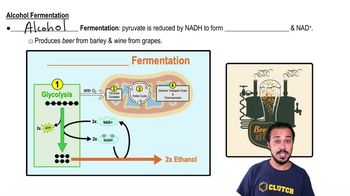
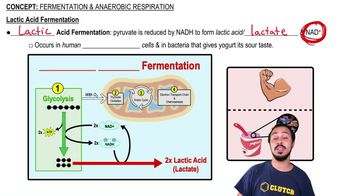
Step 2: Recall that lactic acid is a product of fermentation, specifically lactic acid fermentation, which occurs primarily under anaerobic conditions when oxygen is not available.
Step 3: Analyze the two conditions given: (a) E. coli growing with oxygen (aerobic) and (b) E. coli growing without oxygen (anaerobic). Under aerobic conditions, E. coli primarily uses aerobic respiration, producing less lactic acid.
Step 4: Under anaerobic conditions, E. coli ferments glucose, producing lactic acid among other fermentation products. Therefore, the culture without oxygen is expected to produce more lactic acid.
Step 5: Conclude that the culture described in choice (b) — E. coli growing in glucose broth at 35℃ without O₂ for 5 days — produces the most lactic acid.
비슷한 문제에 대한 검증된 영상 답변:
이 영상 해법은 위 문제에 도움이 된다고 튜터들이 추천한 것입니다.
영상 길이:
1m
영상 재생:
0 댓글
주요 개념
질문에 올바르게 답하기 위해 반드시 이해해야 하는 핵심 개념들은 다음과 같습니다.
Metabolic Pathways in E. coli
E. coli can metabolize glucose through aerobic respiration when oxygen is present, producing mainly CO₂ and water, or switch to fermentation under anaerobic conditions, producing acids like lactic acid. Understanding these pathways helps predict which conditions favor lactic acid production.
Oxygen availability influences E. coli's metabolism; in aerobic conditions, it prefers respiration, minimizing acid production. Without oxygen, E. coli ferments glucose, generating organic acids such as lactic acid, increasing acid concentration in the culture.
Lactic acid is a common fermentation product in bacteria under anaerobic conditions. E. coli produces lactic acid via mixed acid fermentation when oxygen is absent, which lowers the pH and accumulates in the medium, indicating anaerobic metabolic activity.

 1:34분
1:34분 검증된 단계별 안내
 02:17
02:17