Which of the following is not a characteristic of biofilms? a. Antibiotic resistance b. Hydrogel c. Iron deficiency d. Quorum sensing
검증된 단계별 안내
1
Step 1: Understand what a biofilm is. A biofilm is a structured community of microbial cells enclosed in a self-produced polymeric matrix and adherent to an inert or living surface.
Step 2: Review the characteristics of biofilms. Common features include antibiotic resistance due to the protective matrix, the presence of a hydrogel-like extracellular polymeric substance (EPS), and quorum sensing, which is cell-to-cell communication that regulates gene expression in response to population density.
Step 3: Analyze each option in the context of biofilm characteristics: (a) Antibiotic resistance is typical because biofilms protect bacteria from antibiotics; (b) Hydrogel refers to the EPS matrix that holds the biofilm together; (c) Iron deficiency is not a characteristic of biofilms themselves but rather a condition that might affect bacterial growth; (d) Quorum sensing is a key mechanism in biofilm formation and maintenance.
Step 4: Identify the option that does not fit as a characteristic of biofilms. Since iron deficiency is not inherently a feature of biofilms but rather an environmental or physiological condition, it is the correct choice.
Step 5: Conclude that the answer is the option that does not describe a biofilm characteristic, which is iron deficiency.
비슷한 문제에 대한 검증된 영상 답변:
이 영상 해법은 위 문제에 도움이 된다고 튜터들이 추천한 것입니다.
영상 길이:
1m
영상 재생:
0 댓글
주요 개념
질문에 올바르게 답하기 위해 반드시 이해해야 하는 핵심 개념들은 다음과 같습니다.
Biofilm Structure and Composition
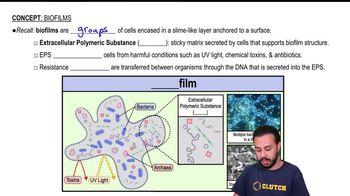
Biofilms are communities of microorganisms attached to surfaces, embedded in a self-produced matrix called a hydrogel. This matrix protects the cells and helps maintain the biofilm’s structural integrity.
Microorganisms within biofilms exhibit increased resistance to antibiotics compared to free-floating cells. This resistance arises from limited drug penetration, altered microenvironment, and protective mechanisms within the biofilm.
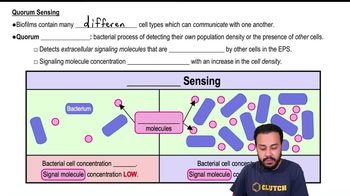
Quorum sensing is a cell-to-cell communication process that bacteria use to coordinate gene expression based on population density. It regulates biofilm formation, maintenance, and dispersal by controlling collective behaviors.

 1:57분
1:57분 검증된 단계별 안내
 03:14
03:14