Which of the following is not a distinguishing characteristic of prokaryotic cells? a. They usually have a single, circular chromosome. b. They have 70S ribosomes. c. They have cell walls containing peptidoglycan. d. Their DNA is not associated with histones. e. They lack a plasma membrane.
검증된 단계별 안내
1
Step 1: Understand the defining characteristics of prokaryotic cells. Prokaryotes typically have a single, circular chromosome, 70S ribosomes, cell walls containing peptidoglycan, and DNA that is not associated with histones.
Step 2: Review each option carefully to see if it matches these known characteristics of prokaryotes.
Step 3: Analyze option (a): Prokaryotes usually have a single, circular chromosome, so this is a distinguishing characteristic.
Step 4: Analyze option (b): Prokaryotes have 70S ribosomes, which is different from the 80S ribosomes found in eukaryotes, so this is a distinguishing characteristic.
Step 5: Analyze option (e): Prokaryotic cells do have a plasma membrane, so stating they lack one is incorrect and not a distinguishing characteristic of prokaryotes.
비슷한 문제에 대한 검증된 영상 답변:
이 영상 해법은 위 문제에 도움이 된다고 튜터들이 추천한 것입니다.
영상 길이:
2m
영상 재생:
0 댓글
주요 개념
질문에 올바르게 답하기 위해 반드시 이해해야 하는 핵심 개념들은 다음과 같습니다.
Prokaryotic Cell Structure
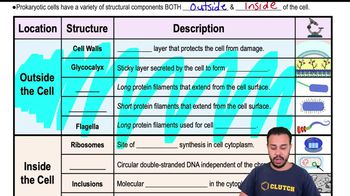
Prokaryotic cells are simple, unicellular organisms without a nucleus. They typically have a single, circular chromosome located in the nucleoid region, and their DNA is not wrapped around histone proteins, unlike eukaryotes.
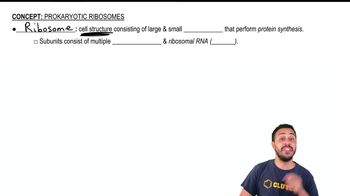
Prokaryotic cells contain 70S ribosomes, which are smaller than the 80S ribosomes found in eukaryotic cells. These ribosomes are essential for protein synthesis and are a key feature distinguishing prokaryotes from eukaryotes.
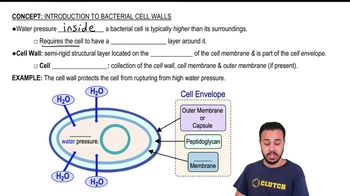
Prokaryotes have a plasma membrane that controls substance movement in and out of the cell. Many have cell walls containing peptidoglycan, a unique polymer that provides structural support and protection, distinguishing them from eukaryotic cells.

 2:19분
2:19분 검증된 단계별 안내
 05:59
05:59