Why is it clinically helpful to know the Gram property of an organism?
검증된 단계별 안내
1
Understand that the Gram property of an organism refers to whether it is Gram-positive or Gram-negative, based on the structure of its cell wall and its reaction to the Gram stain procedure.
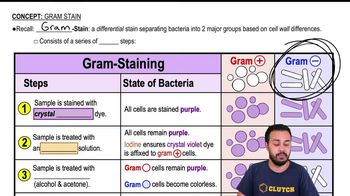
Recognize that Gram-positive bacteria have a thick peptidoglycan layer in their cell walls, which retains the crystal violet stain, appearing purple under a microscope, while Gram-negative bacteria have a thinner peptidoglycan layer and an outer membrane, appearing pink or red after counterstaining.
Know that this distinction is clinically helpful because it guides the choice of antibiotics, as Gram-positive and Gram-negative bacteria often differ in their susceptibility to certain antimicrobial agents.
Realize that knowing the Gram property also helps in predicting the organism's pathogenic mechanisms, potential toxins produced, and typical infection sites, which aids in diagnosis and treatment planning.
Finally, use the Gram property as an initial step in microbial identification in the clinical laboratory, which speeds up the process of determining the causative agent of an infection.
Verified video answer for a similar problem:
This video solution was recommended by our tutors as helpful for the problem above
영상 길이:
3m
영상 재생:
0 댓글
TextbookSolutions.keyConceptsTitle
TextbookSolutions.keyConceptsSubtitle
Gram Staining Technique
Gram staining is a differential staining method that classifies bacteria into Gram-positive or Gram-negative based on their cell wall structure. This technique uses crystal violet and safranin dyes to distinguish bacteria by color, aiding in their identification.
Gram-positive bacteria have thick peptidoglycan layers retaining the crystal violet stain, while Gram-negative bacteria have thinner peptidoglycan and an outer membrane, causing them to appear pink after staining. These structural differences influence bacterial behavior and treatment.
Knowing the Gram property helps guide antibiotic selection, as Gram-positive and Gram-negative bacteria respond differently to drugs. It also aids in diagnosis, infection control, and understanding pathogenic mechanisms, making it crucial for effective clinical management.