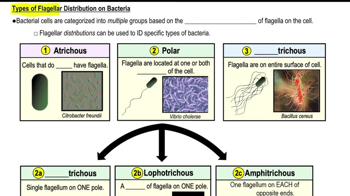
What is the flagella arrangement for each of the pictured bacteria? <IMAGE>
검증된 단계별 안내
1
Understand that flagella arrangements describe how bacterial flagella are distributed on the cell surface, which helps in identifying bacterial motility types.
Review the common types of flagella arrangements: monotrichous (single flagellum), lophotrichous (cluster of flagella at one or both ends), amphitrichous (single flagellum at both ends), and peritrichous (flagella all over the surface).
Examine each bacterial image carefully, noting the number and position of flagella relative to the bacterial cell body.
Match the observed flagella pattern in each image to one of the known arrangements based on their location and quantity.
Label each bacterium with the corresponding flagella arrangement term, ensuring you justify your choice by referencing the visual characteristics.
비슷한 문제에 대한 검증된 영상 답변:
이 영상 해법은 위 문제에 도움이 된다고 튜터들이 추천한 것입니다.
영상 길이:
2m
영상 재생:
0 댓글
주요 개념
질문에 올바르게 답하기 위해 반드시 이해해야 하는 핵심 개념들은 다음과 같습니다.
Bacterial Flagella Structure
Flagella are long, whip-like appendages that enable bacterial motility. They are composed of the protein flagellin and anchored in the cell membrane by a basal body. Understanding their structure helps in identifying how bacteria move and respond to their environment.
Bacteria exhibit different flagella arrangements such as monotrichous (single flagellum), lophotrichous (cluster at one pole), amphitrichous (flagella at both poles), and peritrichous (flagella all over the surface). Recognizing these patterns is essential for classifying bacteria and understanding their motility.
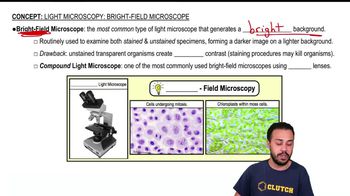
Flagella are often too thin to be seen with standard light microscopy, so special staining techniques like flagella stain or electron microscopy are used. Identifying flagella arrangement from images requires knowledge of these methods and the typical appearance of each arrangement.

 2:04분
2:04분 검증된 단계별 안내

 02:53
02:53