Transfer of DNA from a donor to a recipient cell by a bacteriophage. a. Conjugation b. Transcription c. Transduction d. Transformation e. Translation
검증된 단계별 안내
1
Read the definition carefully: 'Transfer of DNA from a donor to a recipient cell by a bacteriophage.'
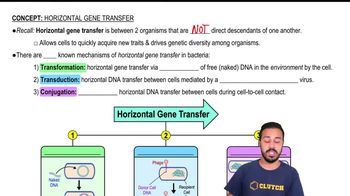
Recall the definitions of each term: conjugation involves direct cell-to-cell contact; transcription is the process of making RNA from DNA; transduction involves transfer of DNA via a bacteriophage; transformation is uptake of free DNA from the environment; translation is the synthesis of protein from mRNA.
Identify the key phrase 'by a bacteriophage' which indicates the involvement of a virus that infects bacteria.
Match this key phrase to the term that specifically describes DNA transfer mediated by bacteriophages, which is 'transduction'.
Confirm that the other options do not involve bacteriophages to ensure the correct match.
비슷한 문제에 대한 검증된 영상 답변:
이 영상 해법은 위 문제에 도움이 된다고 튜터들이 추천한 것입니다.
영상 길이:
3m
영상 재생:
0 댓글
주요 개념
질문에 올바르게 답하기 위해 반드시 이해해야 하는 핵심 개념들은 다음과 같습니다.
Transduction
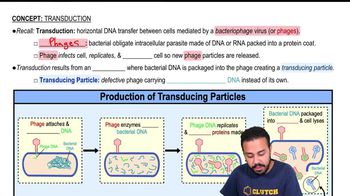
Transduction is the process by which bacterial DNA is transferred from one bacterium to another via a bacteriophage (a virus that infects bacteria). This mechanism allows genetic material to move between cells without direct contact, contributing to genetic diversity.
Bacteriophages can accidentally package host bacterial DNA during replication and inject it into another bacterium. This viral-mediated gene transfer is crucial for horizontal gene transfer and can spread traits like antibiotic resistance.
Horizontal gene transfer includes conjugation, transformation, and transduction, which enable bacteria to exchange genetic material. Understanding these mechanisms is essential for grasping how bacteria adapt and evolve rapidly in various environments.

 3:30분
3:30분 검증된 단계별 안내
 06:49
06:49