Skip to main content
Microbiology
나의 코스
배우기
시험 준비
AI 튜터
학습 가이드
교과서적 해결책
플래시카드
탐험해 보세요
앱을 사용해 보세요
나의 코스
배우기
시험 준비
AI 튜터
학습 가이드
교과서적 해결책
플래시카드
탐험해 보세요
앱을 사용해 보세요
뒤로
Activation of T Lymphocytes quiz
카드를 뒤집기 위해 탭할 수 있습니다.
What types of MHC molecules do dendritic cells possess?
카드를 뒤집기 위해 탭할 수 있습니다.
👆
What types of MHC molecules do dendritic cells possess?
Dendritic cells possess both MHC Class I and MHC Class II molecules.
진행 상황 추적
컨트롤 버튼이 '내비게이션' 모드로 변경되었습니다.
1/15
관련 플래시카드
관련 실천
추천 영상
Activation of T Lymphocytes definitions
Activation of T Lymphocytes
14 용어
Activation of T Lymphocytes
20. Adaptive Immunity
5 문제점
주제
Brendan
Functions of T Lymphocytes
20. Adaptive Immunity
4 문제점
주제
Nicole
20. Adaptive Immunity - Part 1 of 3
7 주제
12 문제점
장
Brendan
20. Adaptive Immunity - Part 2 of 3
6 주제
13 문제점
장
Brendan
20. Adaptive Immunity - Part 3 of 3
7 주제
13 문제점
장
Brendan
07:33
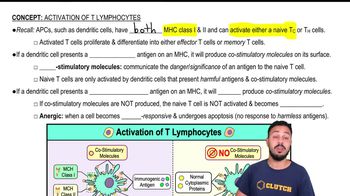
Activation of T Lymphocytes
1472
views
14
rank
03:29
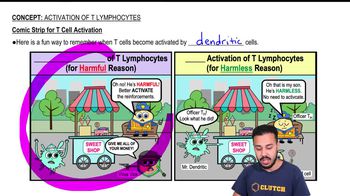
Comic Strip for T Cell Activation
1218
views
16
rank
이 집합의 용어 (15)
하이드의 정의
What types of MHC molecules do dendritic cells possess?
Dendritic cells possess both MHC Class I and MHC Class II molecules.
Which T cells are activated by dendritic cells presenting antigens on MHC Class I?
Naive cytotoxic T cells are activated by dendritic cells presenting antigens on MHC Class I.
Which T cells are activated by dendritic cells presenting antigens on MHC Class II?
Naive helper T cells are activated by dendritic cells presenting antigens on MHC Class II.
What is required in addition to antigen presentation for naive T cell activation?
Co-stimulatory molecules must be produced by the dendritic cell in addition to antigen presentation for naive T cell activation.
What happens to naive T cells when they encounter dendritic cells presenting harmful antigens with co-stimulatory molecules?
They become activated, proliferate, and differentiate into effector or memory T cells.
What is the fate of naive T cells that encounter harmless antigens without co-stimulatory molecules?
They become anergic (unresponsive) and eventually undergo apoptosis.
What does the term 'anergic' mean in the context of T cells?
Anergic refers to T cells that have become unresponsive and do not react to antigen stimulation.
Why is it important for the immune system to distinguish between harmful and harmless antigens?
It prevents the immune system from targeting the body's own healthy cells and avoids unnecessary immune responses.
What do co-stimulatory molecules communicate to naive T cells?
They communicate the danger or significance of an antigen, signaling that an immune response is needed.
What is the outcome when a dendritic cell presents a harmful antigen?
The dendritic cell produces co-stimulatory molecules, leading to T cell activation and an immune response.
What is the outcome when a dendritic cell presents a harmless antigen?
No co-stimulatory molecules are produced, so T cells become anergic and do not initiate an immune response.
Into what two types of cells can activated T cells differentiate?
Activated T cells can differentiate into effector T cells or memory T cells.
What is the role of apoptosis in T cell regulation?
Apoptosis eliminates anergic T cells that would otherwise respond to harmless antigens, maintaining immune tolerance.
How does the comic strip illustrate T cell activation?
It shows a dendritic cell presenting a harmful antigen activating a helper T cell, while a harmless antigen results in no activation.
Why do we not want T cells to respond to harmless antigens?
Responding to harmless antigens could lead to autoimmunity or unnecessary immune responses against healthy cells.
 뒤로뒤로
뒤로뒤로
 07:33
07:33