Skip to main content
Microbiology
나의 코스
배우기
시험 준비
AI 튜터
학습 가이드
교과서적 해결책
플래시카드
탐험해 보세요
앱을 사용해 보세요
나의 코스
배우기
시험 준비
AI 튜터
학습 가이드
교과서적 해결책
플래시카드
탐험해 보세요
앱을 사용해 보세요
뒤로
Active Transport quiz
카드를 뒤집기 위해 탭할 수 있습니다.
What is the main requirement for active transport to move molecules across a membrane?
카드를 뒤집기 위해 탭할 수 있습니다.
👆
What is the main requirement for active transport to move molecules across a membrane?
Active transport requires energy to move molecules against their concentration gradients, from areas of low to high concentration.
진행 상황 추적
컨트롤 버튼이 '내비게이션' 모드로 변경되었습니다.
1/15
관련 플래시카드
관련 실천
추천 영상
Active Transport definitions
Active Transport
15 용어
Active Transport
6. Cell Membrane & Transport
4 문제점
주제
Monica
ABC Transporters
6. Cell Membrane & Transport
3 문제점
주제
Monica
6. Cell Membrane & Transport - Part 1 of 2
7 주제
12 문제점
장
Monica
6. Cell Membrane & Transport - Part 2 of 2
8 주제
13 문제점
장
Brendan
06:57
Secondary Active Transport
15845
views
183
rank
02:37
Active Transport
19297
views
286
rank
02:53
Primary Active Transport
17359
views
236
rank
이 집합의 용어 (15)
하이드의 정의
What is the main requirement for active transport to move molecules across a membrane?
Active transport requires energy to move molecules against their concentration gradients, from areas of low to high concentration.
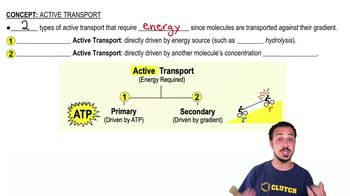
What are the two main types of active transport?
The two main types of active transport are primary active transport and secondary active transport.
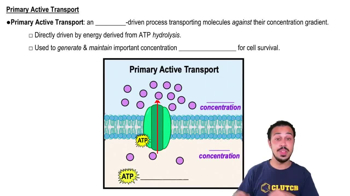
How is primary active transport powered?
Primary active transport is powered directly by ATP hydrolysis.
What is the key difference between primary and secondary active transport?
Primary active transport uses ATP directly, while secondary active transport is powered by the concentration gradient of another molecule.
What membrane protein is a classic example of primary active transport?
The sodium-potassium pump is a classic example of primary active transport.
How many sodium and potassium ions does the sodium-potassium pump move per cycle, and in which directions?
The sodium-potassium pump exports three sodium ions out of the cell and imports two potassium ions into the cell per cycle.
Why is the sodium-potassium pump considered an antiporter?
It is considered an antiporter because it moves sodium and potassium ions in opposite directions across the membrane.
What is the role of ATP in the sodium-potassium pump?
ATP provides the energy required for the pump to move sodium and potassium ions against their concentration gradients.
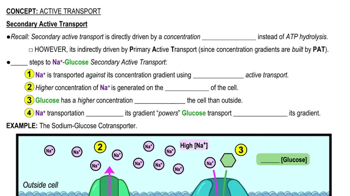
How does secondary active transport obtain the energy needed to move molecules?
Secondary active transport uses the energy stored in the concentration gradient of another molecule, not directly from ATP.
What is a classic example of secondary active transport?
The sodium-glucose transporter is a classic example of secondary active transport.
How does the sodium-glucose transporter work?
It uses the energy from sodium ions moving down their concentration gradient to power the movement of glucose against its gradient.
How is the sodium gradient, used in secondary active transport, established?
The sodium gradient is established by primary active transport, specifically by the sodium-potassium pump using ATP.
Does secondary active transport directly use ATP? Explain.
No, secondary active transport does not directly use ATP; it relies on the gradient created by primary active transport.
What happens to the concentrations of sodium and potassium inside and outside the cell due to the sodium-potassium pump?
There is a low concentration of sodium and a high concentration of potassium inside the cell, and the opposite outside the cell.
Why is understanding both types of active transport important for cell biology?
Understanding both types is essential for comprehending how cells manage energy and maintain necessary concentration gradients for survival.
 뒤로
뒤로
 06:57
06:57