Skip to main content
Microbiology
나의 코스
배우기
시험 준비
AI 튜터
학습 가이드
교과서적 해결책
플래시카드
탐험해 보세요
앱을 사용해 보세요
나의 코스
배우기
시험 준비
AI 튜터
학습 가이드
교과서적 해결책
플래시카드
탐험해 보세요
앱을 사용해 보세요
뒤로
Antibodies definitions
카드를 뒤집기 위해 탭할 수 있습니다.
Antibody
카드를 뒤집기 위해 탭할 수 있습니다.
👆
Antibody
Y-shaped protein produced by plasma cells, capable of binding specifically to antigens and triggering immune responses.
진행 상황 추적
컨트롤 버튼이 '내비게이션' 모드로 변경되었습니다.
1/15
관련 플래시카드
관련 실천
추천 영상
Antibodies quiz #1
Antibodies
10 용어
Antibodies
20. Adaptive Immunity
6 문제점
주제
Brendan
Classes of Antibodies
20. Adaptive Immunity
8 문제점
주제
Nicole
20. Adaptive Immunity - Part 1 of 3
7 주제
12 문제점
장
Brendan
20. Adaptive Immunity - Part 2 of 3
6 주제
13 문제점
장
Brendan
20. Adaptive Immunity - Part 3 of 3
7 주제
13 문제점
장
Brendan
05:40
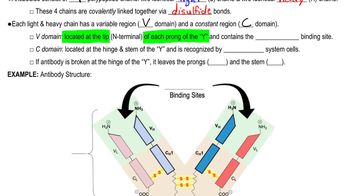
Antibody Structure
1983
views
25
rank
02:34
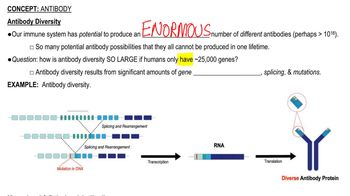
Antibody Diversity
1591
views
16
rank
00:48
Antibodies
1441
views
14
rank
이 집합의 용어 (15)
하이드의 정의
Antibody
Y-shaped protein produced by plasma cells, capable of binding specifically to antigens and triggering immune responses.
Immunoglobulin
Alternate name for a Y-shaped protein that binds antigens, abbreviated as IG and classified into five main types.
Plasma Cell
Specialized immune cell responsible for synthesizing and secreting Y-shaped antigen-binding proteins.
Antigen
Foreign molecule recognized and bound by specific Y-shaped immune proteins, initiating a defense response.
Polypeptide Chain
Linear sequence of amino acids forming part of the Y-shaped immune protein, present as two identical light and two heavy forms.
Light Chain
Smaller, identical pair of amino acid sequences in the Y-shaped immune protein, contributing to antigen binding.
Heavy Chain
Larger, identical pair of amino acid sequences in the Y-shaped immune protein, forming the main structure.
Disulfide Bond
Covalent linkage between sulfur atoms of cysteine residues, stabilizing the structure of the Y-shaped immune protein.
Variable Domain
Region at the tip of each Y-shaped protein prong, containing the antigen-binding site and differing among molecules.
Constant Domain
Region forming the stem and hinge of the Y-shaped protein, recognized by immune cells and remaining unchanged.
FAB Region
Top portion of the Y-shaped protein containing antigen-binding sites, generated by splitting at the hinge.
FC Region
Bottom portion of the Y-shaped protein containing the constant region, important for immune cell recognition.
Antigen-Binding Site
Specific location at the tip of the Y-shaped protein where foreign molecules are recognized and attached.
Gene Rearrangement
Process altering DNA segments to create diverse Y-shaped immune proteins, enabling recognition of many antigens.
Mutation
Change in the genetic code that can result in new variants of Y-shaped immune proteins, increasing diversity.
 뒤로뒤로
뒤로뒤로
 05:40
05:40